Comprehensive Introduction to Rollei Filters for Rolleiflex and Rolleicord
If you are interested in buying some rolleiflex cameras or accessories,
Visit: DZP Camera Cafe
I have a good collection of Rollei filters, Bay I, Bay II and Bay III.
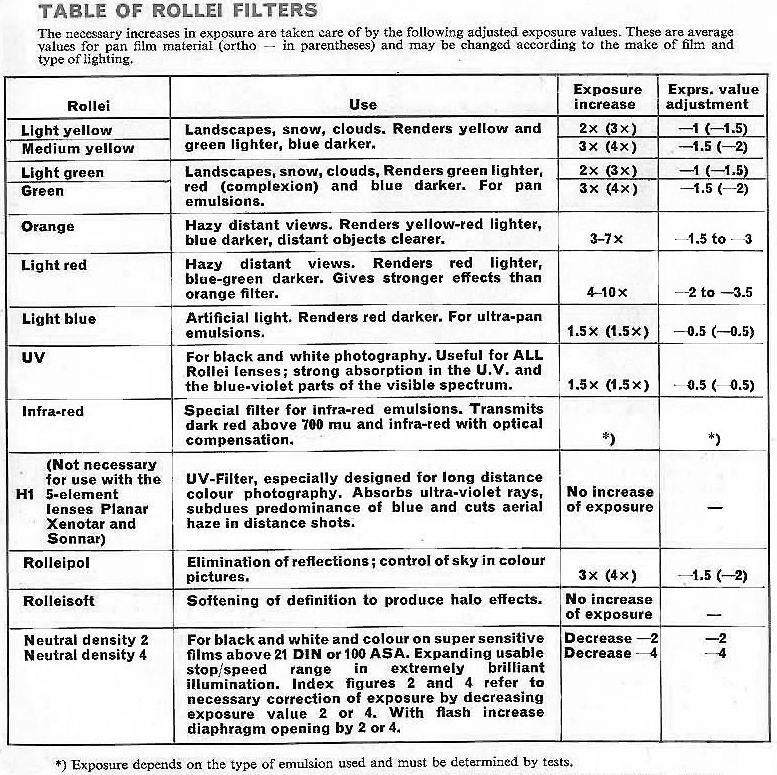
Sometimes the usage of the filters can be confusing. It is difficult to find a single source that could explain the application of all the filters. Hereby I compiled some information here from internet…
If I missed anything, please let me know. Thanks.

Rollei UV
For B&W photography only, it does not work fine for color photography because it has a color tint, this filter has a strong effect to block UV rays, it’s very good for high mountain, snow, water surfaces, high and distant landscapes.
Rollei H1
It could be used for both Black and White and Color films. It is also an UV filter and Skylight filter for landscapes with haze, to eliminate the blue cast coming from the atmosphere, the UV filtering
is soft. It may not work fine for high mountain, snow, water surfaces, high and distant landscapes.
It can be used on Xenar and Tessar lenses;
Planar, Xenotar and Sonnar do not need it as the glasses to make these lenses have built in “similar material”
Rollei Orange
For hazy distant views. It renders yellow-red lighter, blue darker, distant objects clearer
Rollei Hellrot (Light Red)
It is used when distance view is hazy. It renders red lighter, blue-green darker. Gives stronger effects than orange filter.
Rollei R1
This color conversion filter has an UV filter effect and slight color warming effect for Tessar and Xenar lenses, it does not have UV filter effect for Xenotar, Planar and Sonnar but it has slight color warming effect for these lenses.
Rollei R2
It’s a bit stronger than R1 and has UV filter effect and
soft warming effect for every Rollei TLR lens.
Rollei R 1,5
This filter was manufactured from 1957, after R1, R2, R5 and R11 color conversions filters were no longer manufactured (1966), it would be equivalent regarding a Skylight 81 A or B filter.
Rolleinar 1, 2 and 3
Designed for: Close up shots at distances closer than 1 meter,
Use: With the two Rolleinar sets 1 and 2, the Rollei is converted for a focusing range from 39 1/2–17 3/4 (18 1/2) in. and 19 3/4 –12 1/8 (12 1/2) in., see page a. Each set is composed of two optically matched frontal lenses with different mounts. The Rolleinar with the thicker mount is for the viewing lens (Heidasmat) and contains a built-in prism for parallax correction. As a result the field of view in the ground glass coincides with the photograph even at very short distances. A red dot an the mount indicates the uppermost side of the lens for correct positioning in use.
The same instructions apply to the Rolleinars with bayonet size I (see page 2) using a separate Rolleipar parallax corrector for each set. Here too the Rolleipar is always attached to the viewing 1ens Rolleinar red dot up.
Focusing is accomplished as usual an the ground glass screen. The depth of field being rather limited at close range, considerable stopping down is advisable with Rolleinar lenses. The depth of field table indicates the most advantageous stops for the 25 1/4 X 2 1/4 – and 1 X 1 1/2 inch size.
The advantage of a large reproduction should not mislead to indiscriminate shortening of the camera-to-subject distance with close-ups, as this practice would entail danger of distortion. It is less great with objects having a shallow depth of field. For the same reason portrait heads should, if possible, not be taken at distances closer than 40 in.
Rolleinar Lenses require no increase of exposure.
To install: First attach the taking lens Rolleinar and then the viewing lens Rolleinar with prism in front. Insert into the inner bayonet and turn to the right until they click into position. The red dot on the viewing Rolleinar must be up.
Distances are measured from lens board to subject. The figures given in the tables are, for all practical purposes, usable with both 75 and 80 mm. lenses. Permissible circle at confusion = approx. 1/1000 of the focal length at 75 and 80 mm. respectively.
* Figures given in parenthesis apply to a focal length of 80 mm.
Rolleipol
Rolleipol can be used for both color and B&W films.
Purpose: Elimination or subduing al disturbing reflections (glare) from shiny, non-metallic objects or surfaces. Under certain conditions, filtering of the blue sky. Especially useful for regulation of the colors (colored reflections) and control of sky tone in color pictures.
Explanation: If the direction of movement of a light beam is imagined to be the axle of a wheel, then the spokes of the wheel correspond to the various plans of oscillation of the light waves (i.e., we are looking at the light beam in cross section). Polarization will reduce the many planes of osculation to merely one.
Polarization takes place when light waves, striking at a certain angle, are reflected by shiny bodies (with the exception of metals). This polarized segment of light can be retained in full or in part by placing the Rolleipol filter across the plane at oscillation: the reflections disappear. (The filter itself has a polarizing effect an the light which passes through it.) Further, since there is also polarized light in the blue sky, this can be eliminated: the use at the Rolleipol filter results in subdued (darkened) sky portions.
Not all reflected light is polarized. If reflections are to be eliminated, 1, the filter must be turned (an its optical axis) in the direction of the vibrations as required, and 2. the camera position must be changed to gain the best effect. This is attained when the beam of light striking the reflecting body and the line of camera view farm an angle at 60–74′, (varies according to material at the subject).
Application: 1. For eliminating or subduing disturbing reflections when photographing reflecting objects (polish, porcelain, painted and lacquered finishes, etc., — reproduction of textures and material), when photographing glass surfaces and the surface of water (the reflecting surfaces became transparent), 2. for filtering sky when photographing landscapes: the blue sky is darkened by absorption of the polarized light it captains. The effect may be observed in advance by looking through the filter. Light value correction about –1.5 = increase at exposure about 3 X.
For Use: Fasten the Rolleipol filter on finder lens (red dot at the top) and rotate the front ring of the Rolleipol until the desired effect is obtained on ground glass. Note the white number marking and transfer to the taking lens
Rollei – Hellblau (Light Blue Filter)
It is used for portraits in artificial lights: against too pale lips, filter for hypersensitized pan film with artificial lights.
Rolleisoft 0 and 1
Purpose: Softening of super-critical definition producing striking fluffy halo-effects, especially with back-lighting.
Explanation: The taking lens Of the Rollei gives super-critical definition required for the majority of exposures. If, occasionally, softer definition is desired (e. 9. for portraits and certain dramatic effects) this is obtained by attaching the Rolleisoft Soft Focus Lens in front of the lens.
The Rolleisoft lens consists at a plane parallel glass disc with a few concentric ground-in grooves. While otherwise the lens permits only sharpness or softness through adjustment of the focus, the Rolleisoft lens obtains both simultaneously: Between these grooves the rays of light pass unimpeded to the film and produce a sharp impression, i. e., the basis of the image. At the grooves, however, the light rays are diverted with the result that an additional image of slightly softer definition is superimposed. Both together produce the soft focus effect: The exposure shows fluffy softened contours and sunny halo-lights; distracting fine details recede and the fatal impression of depth definition is improved. By means of the Rolleisoft the Rollei-lens becomes a soft focus lens.
Application: Best results are obtained by using the entire surface of Rolleisoft, i. e., with full aperture. With Rolleisoft 1 (with increased number Of grooves) it is permissible to stop down to f: 5.6. Smaller apertures tend to decrease the soft focus effect.
Rolleisoft 0 is used for weak soft faces effect: primarily for strong contrasts of light and glittering objects, i. e., chiefly for backlighted subjects. Rolleisoft t is used for greater soft focus effect: for soft lighting. — Chief field at application generally: portraiture. Best suited tar: contrasting, highlighted subjects. Rolleisoft increases the plastic, sunny character of backlighted pictures. Speed and focal length remain unchanged. Generous exposures increase the halo-effect. The ground glass screen shows full focused sharpness when using Rolleisoft lenses. The Rolleisoft effect can be judged at any time an the ground glass screen by placing the Rolleisoft in front of the finder lens.
For Use: Fasten Rolleisoft to inner bayonet at the taking lens.
Rollei Grun (Green Filter)
It is for B&W photography only. Not for Color films.
A green filter renders yellow-green brighter, red and blue darker. A deeper filter increase this effect. Chief advantage when taking landscapes: brightens foliage, darkens sky for strong rendition of cloud formations, darkens red roofs. Improve detail of blue snow-shadows. For daylight portraits: deeper skin tones, darker red lips – at the same time full UV filter effect – when used with orthochromatic films, the rendition of the red colors will not be influenced.
Rollei Gelb-Mittel (Medium yellow) -1.5
Medium yellow filter often is used for b/w outdoor photography to provide contrast between clouds and sky. Filter facter -1.5 = -2/3 stop correction. When metering, set your handheld meters for film 2/3 stop slower than loaded, e.g. 100 speed to 64.
You also can use it with color film to simulate late afternoon, though you need to experiment a bit.
Rollei Infrarot (Infra-red) filter
It is a special filter for infra-red emulsions. It transmits dark red above 700mu and infra-red with optical compensation. You can only use it with infra-red film, which is expensive and hard to find.
Visually, this filter looks opaque.
Rollei ND filter – ND2 and ND4
It is used for black and white and color on super sensitive films above 100ASA. Expanding usable stop/speed range in extremely brilliant illumination. Index figures 2 and 4 refers to necessary correction of exposure by decreasing exposure value 2 or 4, or with flash increase diagram by 2 or 4.




90 years of Rollei
The founding years
A fortunate coincidence brought together the brilliant
technician Reinhold Heidecke and the experienced
businessman Paul Franke. Their different talents
complemented each other perfectly, and Rollei’s success story
began in 1920 with the foundation of the “Werkstatt für
Feinmechanik und Optik – Franke and Heidecke” in
Braunschweig, Germany. Production began under cramped
conditions, in what had once been a small dance hall, with a
few high-precision machines and a handful of people. A mere
16 months after the company’s foundation, Franke & Heidecke
presented the “Heidoscop”. This initial technical innovation in
the field of stereo cameras laid the corner stone for their
future international success.
The stereo photo received new impetus with the use of roll
film, which had already been developed at the end of the 19th
century. In contrast to the plate technique, it was now possible
to capture multiple images in succession. Taking photos and
the basic handling of cameras thus became more simple and
grew in popularity from the turn of the century.
With the introduction of the “Rolleidoscop” (1923), the first
camera for roll film, F & H then succeeded in making a
decisive breakthrough in 1926, catapulting them into the
vanguard of camera manufacturers. The product name
“Rolleidoscop” simultaneously gave rise to what would later
become the company name “Rollei”, even at this early stage.
The beginning of a camera legend: the Rolleiflex
1928 saw the production of the first ten prototypes of the
legendary twin-lens Rolleiflex. Up until the start of series
production in 1929, it underwent a number of technical
modifications. The patented twin-lens Rolleiflex was notable
for its quality features, which had never been seen before in
this category of camera: an all-metal design with precision film
guide and one of the best lenses of the day, namely the Tessar.
For professional photographers, the first compact reflex
camera with six pictures 6×6 on B1-6 roll film became the
measure of all things. The global demand exceeded all
expectations, and Franke & Heidecke began to expand. The
production facilities, which had already been extended
substantially in 1923, were now no longer sufficient. Shortly
after the company’s 10th anniversary, production was able to
be transferred to a new factory building with 1,400 m.
Work continued without interruption on further development
of the Rolleiflex. In 1931, F & H presented a version for the 4×4
format.
In 1933, the Rolleicord, a scaled-down, cheaper version of the
Rolleiflex, was introduced. In contrast to the expensive 6×6
Rolleiflex costing 178 Reichmark, with a price tag of only RM88, it was also affordable for amateur photographers.
As the enthusiasm for Rollei cameras continued to grow around
the world, the company’s workforce and sales figures also
continually increased. Up to 1935, the company managed to
sell a total of 180,000 cameras. At this point in time, the
factory employed a workforce of around 238.
The crowning moment of this success came when the company
was awarded the “Grand Prix” at the International World Fair
in Paris in 1937. Franke und Heidecke received this prestigious
award for the outstanding design of their Rolleiflex camera.
The same year saw the launch of the 3rd Rolleiflex generation.
Whilst the technical development of photography continued to
advance rapidly in the twenties and thirties, hardly anyone in
Germany dared to accept photography as an art form. Many
photographers did not regard themselves as artists, but simply
as good craftsmen. An initial milestone on the road towards
photography becoming recognised as an art form in Germany
was the Werkbund photo exhibition “Film und Foto” in
Stuttgart. In 1929, international photographers such as Edward
Weston, Immogen Cunningham and Man Ray presented exhibits
there for the first time ever
Profound crisis: the Second World War
The start of the Second World War reduced camera sales and
ushered in a critical time for the now globally operating
company. Rollei fans abroad became enemies and outstanding
accounts in the “enemy nations” led to lost assets. Some 60%
of the factory and company premises were destroyed during
the war, although production was able to be resumed swiftly
once the war was over. Right on time for the currency reform
of 1948, the reconstruction work had already been completed
and all necessary conditions created for the fifties and sixties.
The golden fifties and sixties
The golden age began. Even by 1950, Rollei already employed
more staff than before the war. Optimised models of the twinlens Rolleicord and Rolleiflex were introduced and, in spite of
the numerous copies, global demand was undiminished. On 28
September 1956, the millionth 6×6 Rolleiflex left the factory.
This twin-lens Rolleiflex became the symbol for medium format
photography. It became an icon of its day and was used by
countless travel, fashion and studio photographers. These
defined the unique Rolleiflex photo style.
Work continued on optimisation and further development of
the Rolleiflex product family. An outstanding example was the
Rolleimarin, an underwater housing that had been developed
for series production in collaboration with the diving pioneer
Dr. Hans Hass. The heavy housing, weighing 5.3 kg, satisfied
the increased requirements of underwater photography and
allowed pictures to be taken with the Rolleiflex Automat 3.5
camera at depths of up to 100 m under water.
The death of the two founders of the company, Paul Franke
(1950) and Reinhold Heidecke (1960), cast a shadow over these
successful years. They left a vacuum that posed immense
challenges to the company. The firm was also had to rise to
the demands of devising new innovations to counter the
gradual market saturation in the sector of the twin—lens
medium format camera and the ever-growing significance of
the 35 mm camera.
In spite of the difficult situation, the company Franke &
Heidecke succeeded, under its new management, in presenting
two promising new products in 1966 – the first single-lens roll
film reflex camera SL 66 and the Rollei 35, the most compact
35 mm viewfinder camera of its day. Being the first 35 mm
camera from a German manufacturer, it constantly ensured
high turnover figures, with sales already increasing from 1966
to 1967 from DM 30 to 45 million. In the three decades that
followed, some 3 million Rollei 35 cameras were sold
worldwide. It offered many amateurs the perfect entry-level
camera for 35 mm photography.
During this period, amateur photography became the driving
force of the photo industry. At the same time, photography as
an art form became increasingly accepted. The MoMA photo
exhibitions by Edward Steichen (“The Family of man”, 1955)
and John Szarkowski (1960s) were decisive in ensuring widely
acceptance of photography as an art form. This also coincided
with the trend towards commercial art.
Years of transformation
In 1966, the Franke family acquired all of the Heidecke
family’s company shares. In the wake of growing pressure due
to competition from Japanese camera manufacturers, the
company decided to launch a counteroffensive and moved its
own production to Asia. In 1968, it managed to win
Norddeutsche Landesbank as the majority shareholder (97%) in
an effort to secure the high level of funding required for the
expansion. die hohen Kredite für die Expansion abzusichern.
From the launch of Rollei Singapore (P.T.E.) Ltd. in 1971,
cameras were produced in the Far East, whilst research and
development activities remained in Braunschweig, Germany.
Given the excessively high costs, low production numbers and
obligations towards the Singapore government that could not
be met, this project was ultimately doomed to failure.
One outstanding product to emerge from this period was the
Rolleiflex SLX in 1974. The electronics, automatic functions
and integrated motorised film advance feature were unique for
a medium format camera at this point in time. Fully electronic
cameras, which enabled the aperture, shutter speeds and focus
to be automatically adjusted, made taking photographs
increasingly more user-friendly. A further milestone in photo
history.
From 1974, a period followed for the company that was
characterized by what was in some cases confused model
policy, bad investments and changes of management. In 1981,
the company Rollei-Werke returned to “private ownership”,
with Norddeutsche Landesbank selling its shares to a number of
shareholders — amongst these Hansheinz Porst. From this point
on, the bank that had once been associated with the company
ceased to provide any funding. Only three months later, the
company became insolvent, resulting in the subsequent
liquidation of the business by its creditors.
New company concept – Rollei Fototechnic
In that very same year, a “small contingency solution” was
worked out. The new company “Rollei Fototechnic” was to
take up the old Rollei concept again and use the production
facilities in Braunschweig for producing high-quality, unrivalled
professional products in small quantities.
In January 1982, United Scientific Holdings of London took over
“Rollei Fototechnic”. The new product range included the
proven Rollei cameras Rolleiflex SLX, SL 66 and the SL 2000F,
Rollei’s first 35 mm reflex camera with an interchangeable
magazine. In addition, high-precision opto-electronic
equipment for civil and military use was produced.
The years up to 1986 were also characterised by the return to
the Rollei classics. Special limited editions such as the twinlens Rolleiflex 2,8 F Aurum and the Rollei 35 in gold and
platinum were greeted with enthusiasm the world over.
On 10 July 1987, the German company Optische Werke
Schneider of Bad Kreuznach took over “Rollei Fototechnic”.
The focus was on know-how transfer and the joint utilisation of
the research capacities, taking the latest technologies into
account. In the same year, the modified classics Rolleiflex 2,8
GX with TTL exposure metering and flash control and the Rollei
35 classic caused a sensation. At the photokina exhibition in
1988, the Rolleiflex 6008 was presented as the most cuttingedge medium format camera featuring a new lens.
Digital revolution
Digitalisation has had a major impact on the history of
photography. The first commercially available digital cameras,
which were still referred to as still video cameras, began to
appear on the market from the mid-eighties on. After 1991,
digital photography became increasingly more popular, with
the launch of the first professional cameras.
Rollei Fototechnic entered the world of digital photography in
1991 with the Rollei Digital ScanPack – an add-on for the
Rolleiflex 6008. The images were scanned by means of a highresolution CCD line sensor, saved on the computer and edited
on the monitor. In 1994, the digital imaging system was
extended with the high-speed Rollei ChipPack camera back,
which was followed 4 years later by the DSP-104 digital camera
back.
Parallel to this, analogue photo technology was further
advanced during the nineties. In launching the Prego AF in
1991, Rollei presented its first modern compact camera with
autofocus. In 1995, the Rolleiflex 6008 integral, with a
completely redesigned electronic concept, became the most
state-of-the-art professional camera for the medium format.
With this camera, Rollei succeeded once again in setting new
standards.
In September 1995, “Rollei Fototechnic” was sold to the
Korean conglomerate Samsung. Through integration into this
globally-active corporation, Rollei hoped for a significantly
enhanced competitive position in the high-tech future. The
company was proud of the Rollei / Samsung research and
development centre that was inaugurated in April 1996.
Because of the Asian economic crisis, however, Samsung also
soon found itself obliged to sell off its shares in the company.
The new buyers in 1999 were Paul Dume and six other
managers. In November 2002, the Danish investment company
Capitellum, headquartered in Copenhagen, subsequently took
over Rollei Fototechnic.
The new millennium brought a host of new product releases. In
the spring of 2001, Rollei presented five new compact
cameras, followed by the AFM 35 along with two new digital
cameras in autumn. 2002 saw the market launch of six new
compact cameras, the Rollei d530 flex (a digital reflex
camera), the Rolleiflex 6008 AF (first medium format camera
in 6×6 format with autofocus) and the digital 35 mm camera
Rollei d330 motion. The Rollei 35 RF and the Rolleiflex 4,0 FW
wide-angle camera were also introduced at photokina. The
years that followed also saw the consistent development of the
digital camera lines.
The new Rollei
In 2004, the company Rollei Fototechnic GmbH moved its
production to the newly-founded Rollei Produktion GmbH.
Digital cameras and MP3 players were presented at photokina
under the slogan “The new Rollei”.
In 2005, the company Rollei Produktion GmbH changed its
name again to Franke & Heidecke GmbH. Amongst the
shareholders were two grandsons of the company’s founders:
Kai Franke and Rainer Heidecke. The focus returned to the
production of professional medium format cameras, projectors,
technical photo accessories and lenses at the old company site.
In the same year, the company Rollei Fototechnic GmbH
changed its name to Rollei GmbH and moved its company
headquarters to Berlin. From 2006, it fully gave up the
operative side of the business and concentrated on licensing of
the Rollei trademark rights from then on.
In 2007, the Rollei trademark rights were assigned to three
product categories, thus re-allocating usage: Franke &
Heidecke GmbH received the trademark rights for the
professional medium format products, whilst Rollei Metric
GmbH took over the rights for the cameras in the aerial
photography and surveying technology segment and RCPTechnik GmbH & Co KG the pan-European distribution for
consumer electronic products (digital cameras and
accessories).
Rollei…made by RCP
Since 2007, new Rollei products have been characterised by
their user-friendliness, high quality, modern design and the
excellent value for money they offer. The diverse product
range includes compact digital cameras in the model lines
Compactline, Flexline, Sportsline and the camcorder line
Movieline. Since 2009, digital picture frames and photo/slide
film scanners have also been included in the range.
The ongoing development and high quality of the products is
assured thanks to the company’s own firmware and team of
engineers. The Rollei Service and Call Centre guarantee a high
level of service quality and customer support throughout
Europe.
At the end of 2009, RCP-Technik GmbH can look back over
three successful business years. It has succeeded in increasing
the market share in the compact camera sector within
Germany to 9%. With its digital picture frames, the company
rapidly acquired a 10% market share.
Due to the succesful development of the company, RCPTechnik GmbH has acquired the Rollei brand to 1 January 2010,
and thus coinciding with the start of Rollei’s 90th anniversary
year. The acquisition of the Rollei brand includes the global
licensing rights and points the way towards future
international activities.
On 1 march 2010 the first subsidiary in Hungary was founded.
Distribution to the Balkan region will be continually
developed from the Budapest location. RCP-Technik GmbH’s
Turkish subsidiary will begin operations from Istanbul on 1
April 2010.
Rollei products are currently internationally available in
Austria, Switzerland, France, Italy, Portugal, the UK,
Greece, Sweden, Denmark and the Netherlands. The goal is
to double the number of countries by the end of 2010.
Marking the start of the anniversary year with the presentation
of its Flexline 100 inTOUCH, Rollei has launched a compact
digital camera, which convincingly meets the current needs of
amateur photographers, thanks to its amazing design and
exceptionally user-friendly touch screen. Compact digital
cameras are now increasingly-fashionable accessories, which
we carry around with us wherever we go so that we can send
our snapshots quickly and easily to all our friends via the
Internet and social media.
For this target group, the Rollei compact cameras constitute
the perfect digital companions. In the future as well, Rollei
will be using its products to pick up on the latest trends of the
digital age and making these available to a broad priceconscious clientele seeking value for money


 TLRgraphy