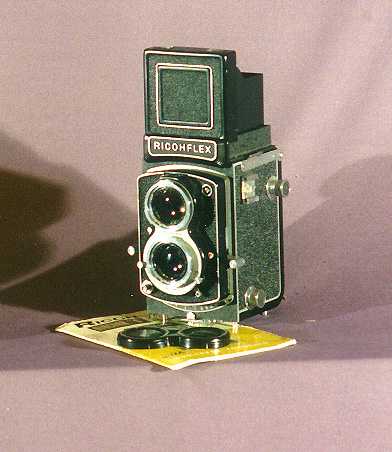
Rocoh Rocohflex TLR
A list of TLR models produced by Ricoh.
Ricohflex Model I, II and V: These model numbers were never used.
Ricohflex Model III: was introduced in 1950. It has the same f3.5 Anastigmat lens as later models but apertures are marked to f22 (instead of f16). Has the Riken shutter with B, 1/25, 1/50 and 1/100 speeds. Compared to the Model VII it has a smaller viewfinder magnifier and a back locking mechanism that isn’t as good. It has a folding viewfinder shade which was changed to the pop-up type in the Model IIIb (photo) which also has the later style larger viewfinder magnifier.
Ricohflex Model IV: Introduced in 1952. Earlier ones are labelled IIII which was later changed to the more correct Roman Numeral IV. Shutter speeds of B and 1/25 to 1/100 are supported. I don’t (yet) know what the differences are from the III and IIIB models.
Ricohflex Model VI: Introduced in 1953, is a manual 6×6 format camera without light meter, using knob film advance with “red window”.
Ricohflex Model VII and VIIs: Introduced in 1954 and 1955, are manual 6×6 format cameras without light meter, using knob film advance with “red window”. Some have the Auto-Stop feature.
Ricohflex Model VII (Seikosha shutter): Introduced in 1954. Has Seikosha shutter with speeds of 1 sec to 1/500 plus B.
Ricohflex Model VIIM: Introduced in 1956. Has shutter with speeds of 1/10 to 1/300 plus B.
Super Ricohflex: Introduced in 1956, is a manual 6×6 format camera without light meter, using knob film advance with “red window(s)”. Some models came from the factory with the Auto-Stop feature (though red window was still present). It was also available as a user-installed option (photo). There were four versions of the Super Ricohflex with three of them having 1/10 to 1/200 shutter speeds but one have 1 sec to 1/500 speeds.
Link to the Super Ricohflex user’s manual.
Ricohflex Holiday: Similar to the Model VII, it has the Riken shutter with limited shutter speeds (B, 1/25, 1/50 and 1/100) but has a flash shoe and film reminder on the wind knob like the Super Ricohflex.
Ricohflex Million: Similar to the Model VII, but has a Riken shutter with speeds from 1s to 1/300. And hot shoe on side as well as PC connector on front panel. Photo coming soon.
Ricohflex Dia: The original Diacord. The name plate says Ricohflex so it is sometimes confused with the geared focusing Ricohflexes. Some Diacord G’s appear to have been nameplated Ricohflex which adds to the confusion. The Diacord L manual shows the camera with a Ricohflex nameplate. So L’s may also have been produced with the Ricohflex nameplate.
Ricohflex Dia M: A cheaper version of the with speeds from 1/10 to 1/300. Photo coming soon.
Ricohflex: The next version of the Dia. Has bayonet 1 fittings on taking and viewing lenses. Has Riconar 3 element taking lens. Photo coming soon.
Diacord G: manual 6×6 format camera without light meter. Knob advance with automatic stop on next frame.
Link to the Ricoh Diacord G User’s Manual.
Diacord L: manual 6×6 format camera with uncoupled light meter. Knob advance with automatic stop on next frame.
Link to the metering section of the Diacord L User’s Manual.
Ricohmatic 225: manual 6×6 format camera, with uncoupled light meter. Has crankwind and shutter cocking with crank, automatic stop on next frame.
Ricoh Auto 66: match needle metered 6×6 format camera (similar to Rolleimagic). Knob advance with automatic stop on next frame.
Ikophot Exposure Meter – Made by Zeiss Ikon
Most of the TLRs do not come with built-in meter.
For TLRs come with built-in meter, most of these may not fully functional due the its age, or some functional but may not be accurate.
In these cases, a good exposure is very useful.
Managed to got a e-copy of Zeiss Ikon Ikophot exposure meter instructional manual, free download here.
Zeiss Ikoflex Twin Lens Reflex – Models Overview
Zeiss Ikoflex Twin Lens Reflex
| Zeiss no. | model | yr built | lens | shutter | comments |
|---|---|---|---|---|---|
| 850/16 | Ikoflex | 1934-37 | f6.3 or 4.5/80 Novar | Compur-Rapid, Klio, Derval | “coffee can” model, lever focus 1936, knob focus after ’36 |
| 850/16 | Ikoflex I | 1939-51 | f3.5/75 Tessar | Compur, Klio, Prontor S | same as Ikoflex II from 1937-39 (851/16) |
| 851/16 | Ikoflex II | 1936-39 | f3.8 CZJ Triotar or f3.5/75 Tessar | Compur-Rapid | lever focus in1937, knob focus after ’37, continued as Ikoflex I (850/16) after 1939 |
| 851/16 | Ikoflex II | 1939-51 | f3.5/70 Novar or f3.5/75 Tessar | Prontor | similar to Ikoflex II of 1937-39 |
| 854/16 | Ikoflex Ia | 1952-56 | f3.5/70 Novar or f3.5/70 Tessar | Prontor | shutter release located on top next to viewfinder |
| 856/16 | Ikoflex Ib | 1956-58 | f3.5/75 Novar or f3.5/75 Tessar | Prontor | improved version of Ia, shutter release located on side next to taking lens |
| 886/16 | Ikoflex Ic | 1956-60 | f3.5/75 Novar or f3.5/75 Tessar | Prontor | metered version of Ib |
| 852/16 | Ikoflex II/III | 1938-40s | f3.5/75 Tessar or f3.5/75 Triotar | Compur-Rapid or Compur | new style Ikoflex II after 1939 |
| 855/16 | Ikoflex IIa | 1950-52 | f3.5/75 Tessar | Compur-Rapid | early version with peep window on each side of taking lens |
| 855/16 | Ikoflex IIa | 1953-56 | f3.5/75 Tessar | Compur-Rapid | restyled version with peep windows directly over viewing lens |
| 853/16 | Ikoflex III | 1939-40 | f2.8/80 Tessar | Compur-Rapid | Albada finder |
| 887/16 | Ikoflex Favorit | 1957-60 | f3.5/75 Tessar | Synchro-Compur | LVS light meter, last Ikoflex |
 TLRgraphy