Rolleiflex T

The Rolleiflex T was originally designed to fit between the budget Rolleicord and the Rolleiflex F models.
The ‘T’ designation is understood to stand for Tessar as the camera is fitted with the cheaper 4 element lens often found on Rolleicords rather than the Zeiss Planar or Schneider Xenotar found on the ‘F’ models.
Some say the T really stands for (T)heodor after its designer Theodor Uhl whose sevices were apparently dispensed with after the bean counters at Rollei saw his handiwork.
That didn’t stop the camera becoming a success with a production timeframe of 1958-76 and about 127,250 units being made.
My version of the camera comes in grey leather and judging by the serial number was produced in the early 1960’s as a rule of thumb most grey cameras are early (pre 1966) a majority of T’s are black.
A list of serial numbers can be found here
should you wish to date your Rollei.
The picture above shows the easiest way to tell the T model from a distance, it is the only Rollei with the shutter button on the side.
Even though the camera is positioned between the budget ‘cord and the pro ‘flex it certainly has more of the Flex’s ‘genes’
I’ve often seen people give the advice to get a Rolleicord over the T as the lenses are pretty much equal and the cords are cheaper, I’d advise that prospective purchasers should get a T as they are much better in daily use.
Below is one of the main reasons I prefer the T to my Rolleicord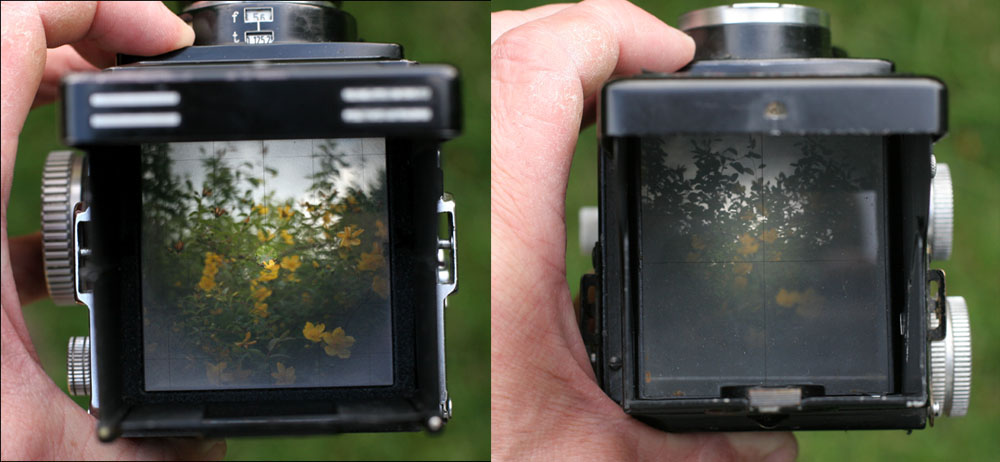
The view above graphically illustrates how much brighter the T is compared to a similar aged Rolleicord, no doubt later Cords have better screens but I’ve always found them duller and slower to focus.
The Tessar lens is a design classic, less elements than the Planar and by some accounts not as sharp at the edges, but for the Portrait type work that TLR’s excel it is a wonderful lens.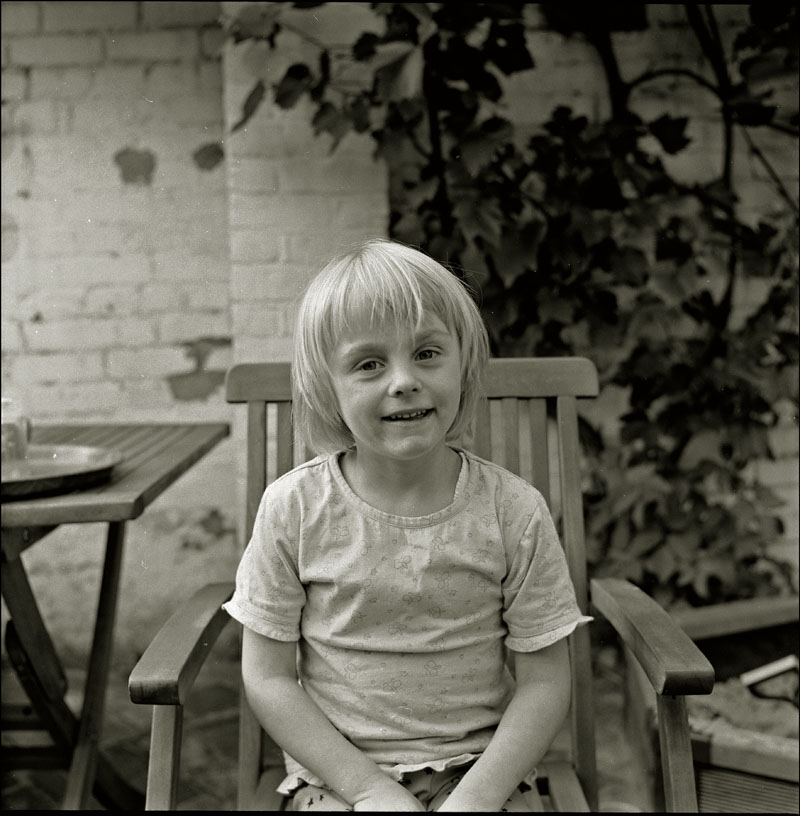

Both of the above images were taken within minutes of ripping open the box, they were taken on Neopan 400 with guessed exposures.
via Photo Utopia: Rolleiflex T.
[If you like this blog, please take a few seconds to take a look of the ads below. Thank you. TLRgraphy will continuously collect the best information about twin-lens reflex cameras]
Comparative Chart of Rolleiflex Twin-Lens Cameras
via Comparative Chart of Rolleiflex Twin-Lens Cameras.
| Model Features | Rolleicord Va / Vb | Rolleiflex T | Rolleiflex 3.5 F / 2.8 F | Rolleiflex 2.8 GX / 2.8 FX |
|---|---|---|---|---|
| years of fabrication | from 1957 to 1977 | from 1958 to 1976 | from 1958 to 1981 | 1987-2002 / 2001- |
| film format | 120 and 135 (Rolleikin) | 120 and 135 (Rolleikin) | 120, 220 and 135 (Rolleikin) | 120 |
| images on 120/220 rollfilm | 12 frames 6×6, 16 frames 4.5×6 or 24 frames 28mmx40mm (120) |
12 frames 6×6 or 16 frames 4,5×6 (120) |
12 frames 6×6 (120) or 24 frames 6×6 (220) |
12 frames 6×6 (120) |
| adaptor back for 6,5×9 plates and cut-film | yes | yes | yes | no |
| Zeiss Optics (taking lens) | no | Tessar 3.5 / 75 mm 4 elements 3 groups |
3.5 F: Planar 3.5 / 75 mm 5 or 6 elements 4 groups |
Planar 2.8 / 80 mm 5 elements in 4 groups, made by Rollei under Zeiss license |
| 2.8 F: Planar 2.8 / 80 mm 5 elements 4 groups |
||||
| Schneider Optics (taking lens) | Xenar 3.5 / 75 mm 4 elements 3 groups |
Xenar (rare) 3.5 / 75 mm 4 elements 3 groups | 3.5 F : Xenotar 3.5 / 75 mm 5 or 6 elements 4 groups | no |
| 2.8 F : Xenotar 2.8 / 80 mm 5 elements 4 groups | ||||
| viewing lens | Heidoscop 3,2 / 75 mm 3 elements | Heidosmat 2.8 / 75 mm 3 elements | Heidosmat 2.8 / 75 mm or 2.8 / 80 mm 3 elements | Heidosmat 2.8 / 80 mm 3 elements |
| standard focusing hood | folding hood, 2.5X lupe, ” sport ” viewfinder | folding hood, 2.5X lupe, ” sport ” viewfinder | folding hood, 2.5X lupe, second 4x lupe and second mirror (” sport ” setup) | folding hood, 2.5X lupe , ” sport ” viewfinder |
| optional viewing accessories | Va : fixed hood, Vb : as T-model | removable ground glass, rigid 2.5X hood, 1.5X prism | removable ground glass, rigid 2.5X hood, 1.5X prism | removable ground glass, rigid 2.5X hood, 1.5X prism |
| bayonet mount for filters or close-up lenses (internal) and lens hood (external) | size I | size I | size II (3.5 F), size III (2.8 F) | size III |
| between-lens mechanical leaf shutter | Synchro-Compur size CR00, B – 1s to 1/500s | Synchro-Compur size CR00, B – 1s to 1/500s | Synchro-Compur sizes CR00 or CR0, B – 1s to 1/500s | Synchro-Compur CR0, then Seiko / Copal no 0, B – 1s to 1/500s |
| mechanical self-timer | yes | yes | yes | no |
| standard flash shoe | no | no | no | yes |
| X-synch, electronic flash | all speeds | all speeds | all speeds | all speeds |
| M-synch, flash bulbs | yes (first models only) | yes (first models only) | yes | no |
| first frame film setup | semi-auto, paper arrow <-> red dot | semi-auto, paper arrow <-> red dot | fully automatic, roller-feeler system | semi-auto, paper arrow <-> red dot |
| film advance | winding knob, not coupled to shutter | folding crank, coupled to shutter | folding crank, coupled to shutter | folding crank, coupled to shutter |
| shutter cocking | separate, manually on taking lens | coupled to film advance | coupled to film advance | coupled to film advance |
| safety lock against double exposure | yes, can be switched off | yes | yes, can be switched off | yes, can be switched off |
| speeds and f/stops controls | lever on taking lens, EV coupling | lever on taking lens, EV coupling | front thumb-wheels on side of lenses | front thumb-wheels on side of lenses |
| display of speeds and f/stops | side windows on taking lens | top windows on viewing lens, with printed belts | top windows on viewing lens, with geared engraved rings | top windows on viewing lens, with geared engraved rings |
| built-in exposure meter | no | external un-coupled selenium cell (optional), diffusor for incident light readings | external inter-coupled selenium cell (optional), diffusor for incident light readings | silicon sensor for available light (viewing lens), and TTL flash SCA 300 (metered by reflection off the film) |
| camera works without battery | yes | yes | yes | yes, except exposure meter system |
| weight (without film) | Va 875g, Vb 940g | 1020g | 1220g | 1235g |
Common features:
- twin-lens reflex, 6×6 format on 120/220 rollfilm, non-removable twin-lens panel,
- focusing by translation of the twin-lens panel, controlled by a left-hand focusing knob,
- automatic compensation for parallax by moving frames under the ground glass.
Other twin-lens Rolleiflex models built in the same period:
- Rolleiflex 3.5E / 2.8E, very similar to 3.5 F / 2.8 F, uncoupled optional exposure meter,
- Rolleimagic with battery-less automatic exposure system,
- Tele-Rolleiflex (fixed telephoto lens, 135 mm)
- Wide-Angle Rolleiflex (fixed wide-angle lens, 55 mm)
- ” Baby ” Rolleiflex 4×4 (127 film only)
Common accessories:
- twin lens cap, leather neck strap and leather ever-ready case,
- bayonet filters, close-up twin-lenses with built-in parallax compensation,
- quick-release tripod plate “Rolleifix” (highly recommended)
References:
- “Rollei-Werke, Rollfilmkameras”, Prochnow, Claus, Rollei-Report Volume II (twin-lens Rolleiflex and SL66), ISBN 3-89506-118-2, LINDEMANNS (1994)
- “Rollei-Werke, Rollei Fototechnic 1958 bis 1998”, Prochnow, Claus, Rollei-Report Volume IV (projectors, flashs, 2.8GX), ISBN 3-89506-141-7, LINDEMANNS (1997)
 TLRgraphy