Overview of Yashica TLR Models
Source: Yashica Twin Lens Reflex Guide – Focal Press January 1964
The Yashica rollfilm reflex cameras are twin-lens mirror reflex cameras made in two sizes, one taking 12 exposures of a size 21⁄4 x 21⁄4 in. (6 x 6 cm.) on standard 120 roll film, the other taking 12 exposures 1 5/8 X 1 5/8 in. (4 x 4 cm.) on 127 roll film.
Two lenses matched for focal length are mounted one above the other on a common panel. The upper lens projects an image of the subject via a mirror on to a ground glass screen in the top of the camera, while the lower one projects a similar image on to the film: the ground glass image therefore shows at all times the full-size picture as it will appear on the negative, upright but reversed left to right. To compensate for any parallax between the viewing and taking lens, the ground glass is suitably masked. The ground glass on top of the camera is protected in the closed position by the folded- down finder hood. When opened, this forms a light-excluding hood 21⁄2 in. high; it carries a magnifier for critical focusing and has a built-in framefinder for eye-level direct vision.
The Yashica reflex cameras are focused by a large focusing knob on the side of the camera. This is geared to the front panel and smoothly and simultaneously controls both lenses. A depth of field indicator is incorporated.
A film speed indicator is built into the centre of the focusing knob except model D and 635, where it is in the film transport knob.
A tripod bush is located in the centre of the camera base. The back of the camera hinges open for insertion of the film. It carries a substantial spring-loaded pressure plate to locate the film precisely in its focal plane. The shutter is released by a body release knob on the front of the camera.
The body is diecast and leather covered. The dimensions of the 21⁄4 x 21⁄4 models are 5 5/8 X 4 1/8 x 3 3⁄4 in., weight from 32 oz. to 40 oz. The 4 x 4 models measure 41⁄2 31⁄4 x 31⁄4 in. and weigh from 24 oz. to 29 oz.
The various Yashica rollfilm reflex models are distinguished from each other by the type of lens built-in, the number of shutter speeds, various automatic features and built-in exposure meter.
Some discontinued models of the Yashica reflex, such as models B, C and 44 which were on the market only for a short time, are so similar to the current ones that they have not been dealt with in the guide separately. There are also several transition variations of the Yashica reflex models listed below. These variations are of a minor nature and the consequent change in manipulation self-evident.
Yashica Reflex Models
The 6*6 models are:
- Yashica A.
As general description above, fitted with Yashikor, earlier models with Yashimar f 3.5 80 mm. three-element, in four-speed Copal shutter, X flash synchronized, film transport by knob, non-automatic, accessory shoe fitted.

- Yashica B.
Similar to A with aperture and shutter speed set by levers on either side of the shutter rim.

- Yashica C.
Adds to model A semi-automatic film transport, speed range from 1 to 1/300 sec., field lens in focusing screen, full XM flash synchronization, Yashikor f3.5 80 mm. lens with bayonet mount for filters, built-in delayed action.

- Yashica D.
Similar to model C with increased speed range 1 to 1/500 sec., aperture and speed setting in cut-out window above finder lens controlled by thumb wheels.

- Yashica 635.
As model D with facilities for using 35 mm. miniature film by incorporating additionial transport knob, film counter and rewind control. Supplied with conversion kit.
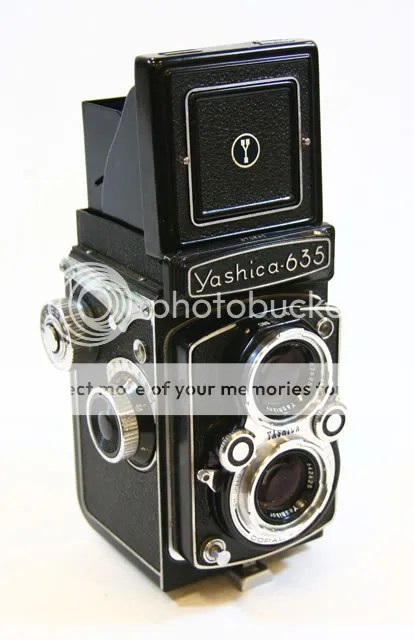
- Yashica Mat reflex.
As general description above, fitted with Yashinon f3.5 80 mm. and finder lens f3.2, shutter 1 to 1/500 sec., built- in delayed action. fully XM synchronized. Aperture and speed setting in cut-out window above finder lens, controlled by thumb wheels with click stops. Film transport fully automatic by lever wind. Fresnel lens in reflex screen.

- Yashica Mat-LM.
As Yashica-Mat, but has built-in photo-electric exposure meter, uncoupled, scale built into focusing knob

- The 4 x 4 models are:
-
- Yashica 44.
As general description above with Yashikor f3.5 60 mm. lens in bayonet mount, crank handle for film transport. Copal shutter speeds 1 to 1/500 sec., built-in self-timer, fully XM synchronized, focusing screen with field lens.

- Yashica 44A.
As model 44 but lens with push-on mount, transport by wheel, non-automatic, shutter speeds1/25 to 1/300 sec., X synchronized, no delayed action release.

- Yashica 44LM.
As model 44 but with Yashinon f3.5 60 mm. lens, with built-in photo-electric exposure meter, uncoupled, scale built into film transport knob, semiautomatic film transport.

- Yashica 44.
Yashica TLR History and Models
Source: Wikipedia
http://en.wikipedia.org/wiki/Yashica
History
The company began in December, 1949 in Nagano, Japan, when the Yashima Seiki Company was founded with an initial investment of $566.[1] Its eight employees originally manufactured components for electric clocks.[2] Later, they began making camera components, and by June 1953 had introduced their first complete camera, the Yashimaflex, a twin-lens reflex (TLR) medium-format camera designed for 6x6cm medium format film. While the Yashimaflex used lenses labeled Tri-Lausar, successive models used Yashikor and Yashinon lenses. All of these lenses were manufactured for Yashica by the Tomioka Optical Works, beginning a relationship that would last for many years.[3] Late in 1953, Yashima Seiki Company became Yashima Optical Industry Company, Ltd.[4]
In 1957, Yashima founded Yashica, Inc., a subsidiary arm in New York City to manage marketing efforts in the USA.[5][6] 1957 also marked the introduction of a popular new TLR camera series, the Yashica Mat line.,[7] as well as an 8mm cine movie camera. During the next year and a half, Yashima continued to grow, with 1,982 employees by 1958.[8] Later in 1958, Yashima changed its name to Yashica Company, Ltd, when it acquired the Nicca Camera Company, Ltd.[9] The Nicca acquisition was fortuitous, as the designs acquired assisted Yashica in expanding its product line into advanced 35mm rangefinder cameras.
The Yashica Pentamatic, an advanced, modern 35mm Single Lens Reflex (SLR) camera with a proprietary bayonet-mount, automatic diaphragm (offered only with the Auto Yashinon 50mm/1.8 lens), and interchangeable lenses, was introduced in 1959. As before, Yashica continued to source its lenses from the Tomioka Optical factory.
Around 1959–1960, Yashica acquired the assets of the bankrupt Zunow Optical Industry Co. Ltd.[10][11] Though a small company, Zunow had become known for limited production of a very advanced 35mm SLR camera, along with several high-quality, fast 35mm camera and 8mm cine (movie) lens designs and a proprietary bayonet-mount lens system similar to that of Yashica Pentamatic. With the assistance of Tomioka Optical Works, Yashica adapted Zunow lens designs into its own 8mm turret cine (movie) cameras.[12]
Like Zunow, Yashica found it difficult to gain market acceptance with its proprietary SLR lens mount, and redesigned its SLR camera line in 1962 to accept the Contax/Praktica M42 lens mount.[13] The new SLR camera was introduced as the Penta J.
In December 1965, Yashica introduced the world’s first commercially successful electronically controlled 35mm camera, the Electro 35, a popular rangefinder model that in various model subvariants eventually sold 8 million units.[14] The company continued to expand its international markets, and in August 1968, Yashica finally acquired its lens manufacturer, the Tomioka Optical and Machine Manufacturing Co., Ltd. (later renamed the Tomioka Optical Co. Ltd.).[15] By this time, Tomioka was one of the largest and most reputable lens manufacturers in Japan. Sales of 35mm SLRs continued to grow steadily, and Yashica was quickly acquiring a reputation for both electronic camera expertise and high-quality optics. 1968 also marked the year of Yashica’s last major TLR camera design, the Yashica Mat-124, a popular model which combined some of the best features of Yashica’s earlier TLR cameras.
In 1968, Yashica introduced the TL Electro-X 35mm single lens reflex (SLR) camera and produced it until 1974. It had a screw thread lens mount, the M42 lens mount, for its interchangeable lenses. It also had an all-electronic through-the-lens exposure meter in the viewfinder using LEDs. The Copal Square SE shutter, a vertically-travelling metal blade focal plane shutter made by Copal Corporation, used in the camera, was electronically controlled.[16][17]
In 1972, Yashica introduced the TL Electro 35mm SLR camera which was similar to the Pentax Spotmatic camera made by the Asahi Optical Company (Pentax). The TL Electro also used the electronic exposure LED’s that the prior TL Electro-X had introduced as well as the M42 screw threaded lens mount for its interchangeable lenses.[18][19]
In 1973, Yashica the company began a collaboration with Carl Zeiss it called Top Secret Project 130 to produce a new, professional 35mm SLR with an electronically controlled shutter bearing the Contax name, and called the RTS (for ‘Real Time System’).[20] A new prestige line of Yashica / Contax lenses designed by Carl Zeiss were introduced for the camera, with a common C/Y bayonet mount allowing lens interchange between all 35mm Contax and Yashica SLR camera models.[21] The F. Alexander Porsche Group was hired to complete an ergonomic and styling study of the new camera. The new Contax RTS appeared at Photokina in 1974, and became a commercial success.

Top of FRII
Yashica soon introduced several new 35mm SLR cameras beginning with the FX-1 (1975) and FX-2 (1976). Also in that year, in response to the success of the Contax RTS, Yashica developed the upscale Yashica FR utilizing some of the features of the RTS, including its electromagnetic shutter release.[22] The FR was capable of using the entire range of Carl Zeiss T* lenses. In contemporaneous tests, the FR was described as being tougher in some ways than the more expensive Contax RTS, including better sealing against dust and contaminants.[23] This practice of ‘pairing’ similar Contax models with more affordable, less full-featured, but still high-quality Yashica models would continue for the next 10 years. The FR was quickly followed in April 1977 by the FR-I and FR-II.[24] The FR-I was an 35mm SLR offering even more features of the RTS, including an electronic shutter with both manual and aperture priority modes, and marked the high point for the Yashica brand in competing with Nikon, Canon, and Minolta for the semi-professional SLR camera market.[25]

A Yashica FX-3 Super with a 500mm mirror lens.
In 1979, Yashica introduced a new inexpensive 35mm consumer SLR, the FX-3, intended for entry-level buyers.[26] Like all Yashica manual-focus bodies, the affordable FX-3 featured a C/Y lens mount that would also accept Carl Zeiss T* lenses. This simple, lightweight manual-exposure SLR camera sold well, and with minor revisions, stayed in production until 2002.
In October 1983, Yashica Company Ltd. was acquired by ceramics giant Kyocera. Initially, the merger resulted in few outward changes. The manual-focus (MF) FX-103 Program, introduced in 1985, continued the ‘pairing’ tradition of high-end Yashica SLR models with Contax (Contax 159mm), and was the first Yashica SLR with TTL flash and full programmed exposure capabilities.
After 1983, all Yashica brand cameras were marketed by Kyocera (Kyoto Ceramics), which also made newer Contax cameras. By 1985, the company was facing intense market competition from other manufacturers, especially Minolta, which had introduced a competitively priced and advanced autofocus 35mm SLR camera. Yashica eventually introduced its own autofocus 35mm SLR camera line that was overpriced and poorly marketed in comparison to its competition. In response, Kyocera gradually repositioned the brand as a budget-priced ‘point & shoot’ line, moving production from Japan to Hong Kong, and discontinuing all high-end SLR camera production.
In 2005, Kyocera halted production on all Contax, Yashica, and other Kyocera branded film and digital cameras.[27] In 2008, Kyocera sold the trademark rights of Yashica to Hong Kong-based MF Jebsen Group, and is under its subsidiary JNC Datum Tech International, Limited. Yashica’s products from JNC Datum Tech International including digital cameras, digital camcoders, digital photo frames, portable DVD players, digital audio players, digital voice recorders, binoculars, mobile phones and SD cards.
TLRs

Yashica Mat-124 G.
- Pigeonflex
- Yashica 12
- Yashica 24
- Yashica 44
- Yashica 44A
- Yashica 44LM
- Yashica 635
- Yashica A, B, C, D [1]
- Yashica EM
- Yashica Mat
- Yashica Mat 124
- Yashica Mat 124 G
- Yashimaflex
Weight of a Rollei TLR
Weight is always a concern if you frequently shop on ebay. Shipping cost can be high, especially for international bidders. Normally it costs 45-55 USD to ship a Rollei TLR from US to Asia via USPS express. Might be slightly cheaped if shippied via priority mail.
The item is bulky and heavy. Here is a compiled list of weight of different models of Rollei TLR. Hope it is useful for your online shopping.
| Brand | Model | Weight |
| Rolleiflex | Original | 720g |
| Rolleiflex | Old Standard | 800g |
| Rolleiflex | Automat I-III | 920g |
| Rolleiflex | New Standard | 900g |
| Rolleiflex | 3.5/x | 980g |
| Rolleiflex | 3.5A/MX | 970g |
| Rolleiflex | 3.5B/MX-EVS | 980g |
| Rolleiflex | 3.5C | 1120g |
| Rolleiflex | 3.5E/E 2/ E3 | 1120g |
| Rolleiflex | 3.5F | 1220g |
| Rolleiflex | T | 1020g |
| Rolleiflex | Tele-Rolleiflex | 1535g |
| Rolleiflex | Weitwinkel-Rolleiflex | 1355g |
| Rolleiflex | Rolleimagic | 1000g |
| Rolleiflex | Rolleimagic II | 1000g |
| Rolleiflex | 2.8A | 1080g |
| Rolleiflex | 2.8B | 1080g |
| Rolleiflex | 2.8C | 1140g |
| Rolleiflex | 2.8D | 1140 |
| Rolleiflex | 2.8E/ E2/ E3 | 1250g |
| Rolleiflex | 2.8F | 1220 |
| Rolleiflex | 2.8GX | 1230g |
 TLRgraphy