MAMIYA C330F – The Best Mamiya TLR
Description and function of the C330F camera, and it’s capabilities, flaws and quirks.
The MAMIYA C-330F was the final version of the “C” series cameras built by the MAMIYA camera corporation of JAPAN. The “F” model was the final model produced into 1980 by the MAMIYA corporation, it was a moderatly priced unit that came with an 80mm (normal) lens, that allow professionals, and advanced amateurs to create with a great deal of flexibility and capability in the medium format 6cmX6cm (2.25″x2.25″) square realm. The twin lens system on an extension bellows allowed for extreme closeups without the use of closeup lenses or extensions, and there are a number of accesories available for this camera as well. Here are it’s following abilities;
 |
- uses 120 and 200 film
- Self cocking with film advance on most of the lenses (not on the 180 or 250mm though)
- Double exposure capable
- Interchangeable focus screens
- right angle viewers (porrofinders) available
- parallax correction devices
There are a number of safety interlocks to prevent ruining film, or accidental exposures from occuring, until the user get’s used to them, they can be detrimental to action photography, as it’s easy to mis a shot from not setting things just right on the camera. The porro finders also suffered from low light when used, mostly with the mirror type, but some complaints with the prism were heard as well. The lenses are all excellent quality and design, the give supperior photos, usually only seen with German or Russian optics, comparable to the Japanese lenses used in the KONI OMEGA Rapid 100,200 and M series. The lenses available are as follows;
- 55mm (wide angle) F4.5
- 65mm (wide angle) F3.5
- 80mm (normal) F2.8
- 105mm (normal ,good portrait lens) F3.5
- 135mm (telephoto) F4.5
- 180mm (telephoto) F4.5
- 250mm (telephoto) F6.5
Some users including myself have found that the 180mm and 250mm old style lenses don’t quite fit the MAMIYA C330F camera, the lens connection is the same, but he aluminum and steel cases of the lenses are just a little too big, and jam the self cocking lever. I have a perfect old style 180mm that I carefully marked with a map pencil as to the area of the case that the cocking lever rubs across when operating, and then ground down the case in that area with a DREMEL rotary tool, and the used sanding cuffs the the dremel to smoooth it out, now the camera works with the lens, and allow the film to advance, with the 180 and 250mm you have to cock the lens manually anyway, so this isn’t a big issue.
Manual for C330F
http://www.butkus.org/chinon/mamiya/mamiya_c330f_prof/mamiya_c330f_prof.htm
Photos by Mamiya C330F:
A beautiful set about portrait:
http://www.flickr.com/photos/donlam/tags/c330f/page4/
Another set about landscape and stills:
http://www.flickr.com/photos/46665374@N06/sets/72157623230753752/with/4376981854/
GANGNAM STYLE

繼續播放吧~~~
“Gangnam Style” is a Korean language
colloquialism that refers to a luxurious lifestyle associated
with the Gangnam district,
an affluent and trendy area of Seoul.
In Korean colloquialism,
may be translated as
“I am (loving) the Gangnam style.”
or liberally translated as
“I am Gangnam style.”


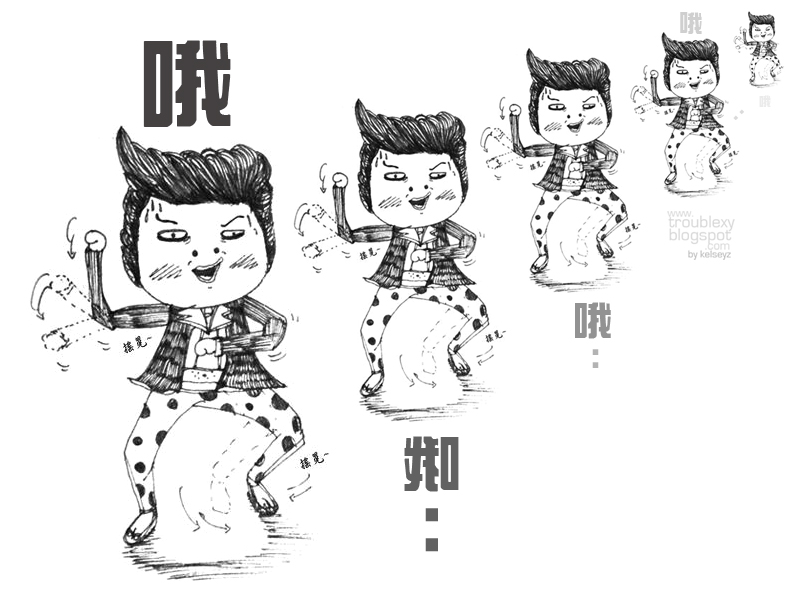




OPPA
OPPA
OPPA OPPA OPPA OPPA
OPPA OPPA OPPA OPPA OPPA OPPA
OPPA OPPA OPPA
OPPA OPPA
OPPA
GANGNAM GANGNAM GANGNAM
GANGNAM
STYLE !!!!
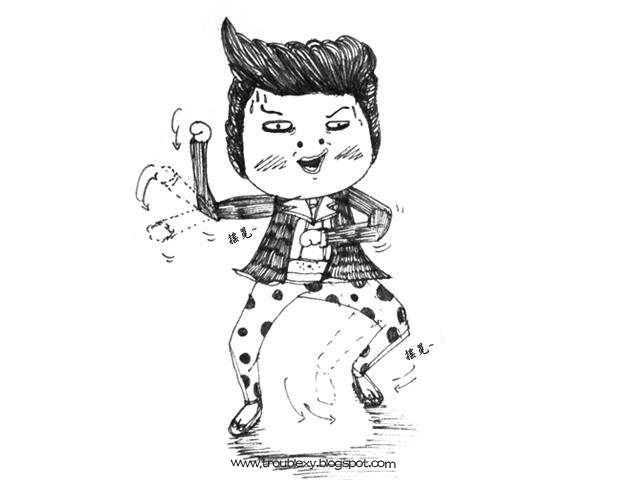
via TROUBLEXY小凡烦插画之梦工厂: ::: GANGNAM STYLE 輕插畫 / PSY / 感染力超強 !!!!! :::.
Sawyers Mark IV
Sawyers are best known for their viewmaster 3D viewing system, where stereo images are arranged on a wheel. To complement this range, they commisioned or rebadged a number of cameras (including the Ace Ajoy renamed the Nomad). Most of these cameras were of course 35mm stereo, and are highly collectable. However their most noteworthy 127 offering was a regular (though rather nice) TLR – the Sawyers Mark IV.

The designation Mark 4 is a bit strange, as there was never a 1, 2 or 3. I can only imagine that the 4 refers to the 4×4 format, and the Mark bit was put in to give a Japanese camera that Mark Twain/Tom Sawyers link to America culture.
The image and manual were submitted by Dave Schneller who inherited his Mark IV (S#274930) from his father. The following is quoted from http://medfmt.8k.com/mf/sawyer_mark_IV.html by Karl Bryan
The Sawyer’s Mark IV twin lens reflex cameras are a rebadged Primo Jr. Type 1. Manufactured by Tokyo Optical Co. and imported by the Beaverton, OR GAF Co. (makers of the Viewmaster). The Sawyer’s Mark IV Type I was in production from 1958-1959. This camera is a 4×4 format utilizing 127 film. Note that the proper lens cap acts as a shutter release lock.
Shutter is a Seikosha MXL, B, and 1-500 speed with M, F, X flash synch. The camera shutter has markings for EVS (Exposure Value System, also known as the Light Value System). The EVS is a cross coupled system between shutter speed and aperture with EVS values from 3-18. The aperture and shutter settings are viewable from the small window above the viewing lens.
The lens is a Topcor 60, f2.8 multicoated, four element, 3 group, tessar design. F stops are from 3.5f to 22f, film wind is by crank with automatic setting of the shutter. Filters are the typical Bay 1 type.
Film setting is by the red window to frame 1, and then it is automatically indexed. When first installing film, wind the crank until the number 1 appears in the red window in the back of the camera, depress the button above the wind crank and slide the button next to is towards the back of the camera. This set the frame counter to 1, then film indexing automatically occurs every time the film crank is wound.
Focus is by knob with an ASA reminder dial in its end. Above the focus knob is a Depth of Field scale. The film chamber is baffled for flare control.
The ground glass has a fresnel lens with center focus spot and cross hair etched lines for aid in composition.
Finally for your 127 using enjoyment: The Sawyers Mk IV manual.
via 127:Sawyers.
 TLRgraphy