Classic Portraiture: Always in Style – by Peter Skinner
This is the the introduction chapter from my fav book “Classic Portrait Photography – Techniques and Images from a Master Photograher”.
Recent i found an online digital copy of this book. you can download here.
Classics, whether they are suits, movies, or books, simply never go out of style. If something is good—really good—it will stand the test of time. And that can
definitely be said of the portraits created by one of the masters of the genre, William S. McIntosh. For more than 50 years, Bill McIntosh has been carving his
name in the annals of portraiture, setting himself ever higher artistic and professional goals.
His mission statement, and the one on which he has based all his work, is simple: “If I am going to put my name on it, it will be the very best that I can do. I will not leave a portrait session until I know I have done my best to make the customer
happy.”
Recently, he was named by the prestigious English publication Creative Image Magazine as one of the five best portrait photographers in the world. It is
not an honor that McIntosh himself necessarily subscribes to, quickly pointing out that such distinction is purely subjective. That aside, however, it is indicative of the esteem in which his work is held, both in the U.S. and internationally. McIntosh has garnered many awards and honors. He holds PPA’s Master of Photography, and is a Fellow of the American Society of Photography, the British Institute of Professional Photography, and the Royal Photographic Society of Photography.
He is also an Honorary Fellow of the Master Photographer’s Association. While recognition from organizations such as these is rewarding, McIntosh’s goal has been making the people in front of the lens happy with their portraits. The reason is simple: if they don’t like the results, the photographer does not stay in business.
McIntosh’s entry into photography began in 1947 (in the aftermath of World War II, during which he was stationed in Japan) and took advantage of the GI bill, which had been doubled at that time to make military service more appealing. Young Bill McIntosh was certainly frugal, as well as a little lucky and undoubtedly ambitious.
The lucky part was winning a 35mm rangefinder Clarus camera with a 50mm lens in a PX raffle. He then used a variety of innovative and commercially oriented ploys to obtain film. He began documenting his postwar Japan experience. Film was hard to come by, and McIntosh treated each exposure with the attention it deserved.
For example, he took about two weeks to expose one roll of film, at times going for two days or more before making a picture, even though he was looking for images the whole time. “I wrote a script of everything I wanted to photograph to record my experience in Japan and I took my time, making sure I got everything on the list on the one 36 exposure roll,” he says. From this venture he sold some 200 sets of prints, making about $200 in the process. Not bad for a young soldier who had yet to finish high school.
While in Japan, McIntosh benefited from another source, a book which not only nspired him, but instilled within him aspirations of striving for the very best in portraiture. The book was Yousuf Karsh’s Faces of Destiny (Ziff-Davis Publishing, 1946), portraits of wartime leaders such as Winston Churchill, Lord Mountbatten, and Eisenhower. “The portraits in that book became my ideal and I wanted to make pictures like them. From then on, I worked at full speed, but it took me until the mid-to-late 1950s before I reached the quality that I sought,” he says.
McIntosh credits Karsh and three other great portrait photographers as having one the most to advance the craft. These are Julia Margaret Cameron (born in England in 1815 and considered the finest early portrait photographer), Edward Steichen, and Arnold Newman. While maintaining that he could never get access to inter
national figures such as Karsh photographed for his Faces of Destiny project, which was funded by the Canadian government, McIntosh has photographed an
impressive list of international dignitaries and leading citizens of Virginia—virtually the aristocracy of Virginia—including statesmen, politicians, military leaders, writers, and photographers. Among his subjects are Colgate Darden, a governor of Virginia and one of the state’s outstanding leaders; well-known New York political figure Mario Cuomo; Richard Gasso, Chairman and CEO of the New York Stock Exchange; General Colin Powell, currently Secretary of State but at that time chairman of the Joint Chiefs of Staff; writer Tom Wolfe; writer David Baldacci; TV commentator
Larry King; legendary baseball great and baseball Hall of Fame member Yogi Berra; and numerous other well-known figures.
One of his favorite self-assignments was a series of portraits he made of celebrated contemporary photographers, including Yousuf Karsh, Arnold
Newman, Jay Maisel, Gordon Parks, Aaron Siskin, Alfred Eisenstadt, and Cornell Capa, which were exhibited in the International Photography Hall of Fame in Oklahoma City. Portrait photographers will resort to all manner of antics and
chitchat to get the most out of a session, and McIntosh used his own brand of outrageous humor and other ploys when working with his colleagues in the fa-
mous photographer series—with great results. In his career, McIntosh has
achieved a long-term goal, up- grading his portrait photography to an art form and being recognized as an artist. In 1964, he photographed the leading 22 painters in Virginia, and the portraits were displayed in an exhibit together with examples of the artists’ work. An excellent review by a local art critic led to the director of what is now the Walter Chrysler Museum inviting McIntosh to exhibit in the museum. The theme for that first museum exhibit in February 1968 was “The Cultural Life of
Norfolk,” which included portraits of painters, symphony principals, and ballet performers. The exhibit was such a success that it opened many other doors, and McIntosh was able to organize theme exhibits to hang in bank lobbies, libraries, schools, and large shopping malls. His portraiture had become wall art, now anging in many places traditionally dominated by paintings. For example, canvas prints of his portraits hang in the Federal Court House, the Pentagon, Annapolis, and Old Dominion University. In September 2001, a 50 year retrospective of his work was exhibited in the Chrysler Museum, the institution which opened its doors to him in 1968.
Bill McIntosh began his business and marketing plan when he returned from Japan to complete high school and began to take pictures for the school yearbook. At that time, year books were a low-end product, and the photography was mediocre at best. As luck would have it, the student advisor in charge of yearbook production wanted to upgrade the publication. Says McIntosh, “She wanted to produce an award-winning year book.” In young Bill McIntosh she found the ideal, go-for-it photographer. His style caught on, and soon he was the year book shooter for all seven local schools. Over time, McIntosh and his team picked up all the schools in the Norfolk and Virginia Beach area, eventually dominating the market for 31 years. The timing was impeccable. In those postwar years, the number of high-school seniors increased by about 20 percent a year for 20 years, creating an ever-expanding market.
And schools were not McIntosh’s only market—portraits, children, pets, and a variety of other commercial subjects became part of his far-reaching operation, which included three studios employing 40 people. In 1981, McIntosh sold the business, a move that allowed him the freedom to focus on what he loves best: portraiture on location, and especially executive portraiture. Today, his work is mostly on location, with some exclusive sessions made on 4×5 film for large, wall-size portraits. With his daughter Leslie, McIntosh operates a studio by appointment only. He devotes most of his time to location assignments. And when on location, he spares no effort to light the subject and the environment to his own demanding requirements. He uses a combination of ambient light, numerous flash units, reflectors, and umbrellas. His lighting is both classic and contemporary—and he still uses Polaroid film for testing. Whatever it takes, he will use. As of this writing, digital portraiture on the highest level for large, wall-size prints has not matched the quality of film. He believes it will fairly soon, but it will still be some time before it is economically practical for the high-end portrait artist with a low volume of work.
The advice McIntosh would offer young photographers, based on his own modus operandi, is to learn as much as you can about the subjects beforehand—including getting biographies and current portraits of civic leaders and other public figures so you have a foundation for down-to-earth conversation and communication during the session. Then, strive to make a positive and uplifting visual statement about the people you photograph. It’s worked for Bill McIntosh for more than half a
century, and it continues to work for him today.
Peter Skinner is a contributing editor to Rangefinder and Photographic magazines, and his articles have appeared in other photographic publications including Outdoor Photographer and the European magazine Opticon. From 1991 to 2003 he served as publications editor and communications director for the American Society of Media Photographers (ASMP). He is also an accomplished photographer whose images have appeared in numerous publications in the U.S. and abroad.
People with Yashica Mat 124
Awesome self-portraits using Yashica Mat 124 TLR. hand picked from flicker.com by TLRgraphy


by …storrao…


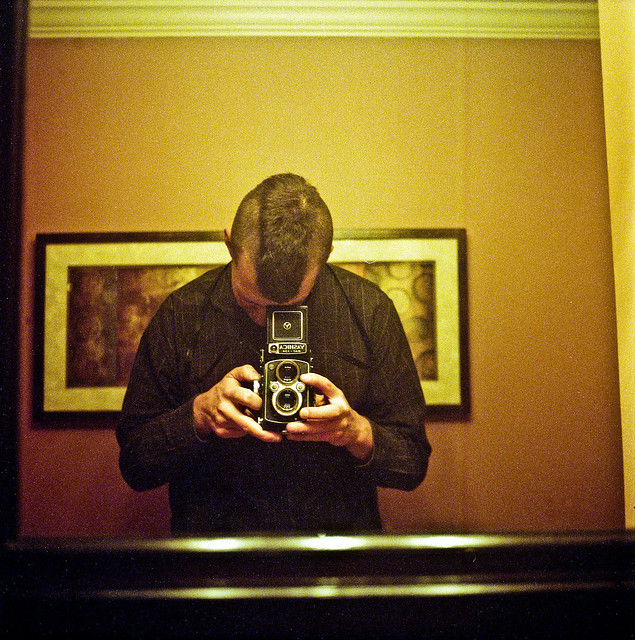


by Happy_Axe


Yashica Mat 124 in-depth review
Yashica Mat 124 – Review by Karen Nakamura
Overview and Personal Comments
The Yashicamat 124 is a twin-lens reflex (TLR) camera that is basically a copy of the Rolleiflex. It uses 120 size film (medium format) to shoot 6 x 6 square format photos (same as a Hasselblad). Using the text or images on this website without permission on an ebay auction or any other site is a violation of federal law.
I purchased this camera a couple of years ago to see if medium format was my thing. It was, the Yashica had excellent resolution and the tonality of medium format positives just blew me away.
Unfortunately, I was so entranced by the Yashicamat, I later on bought a Mamiya RB67 system and never used the Yashicamat after that. The RB67 is for the studio, while I have a Koni-Omega Rapid M for outdoor medium format photography. It’s just a bit difficult to frame when things are reversed in the TLR finder. I like the look of the 124 and the little Yashica 44LM, but I doubt I’ll ever use them.
Interesting quirks
The Yashicamat 124G is the successor to the 124. Everyone seems to want the 124G. The only change the 124G has was to add Gold meter contacts. That’s it. Which is odd since I’ve seen 124Gs that went for $400, but 124s are relatively cheap. They use the EXACT SAME OPTICS! Hmm.. People are pretty stupid. You don’t buy Yashicamats for the lightmeter, heck most of them are non-linear anymore. They use the EXACT SAME OPTICS!*
* OK, so the 124G had a nicer finish on the outside, BUT it also used wimpier (i.e., cheaper) gears. The 124 has sturdier internal mechanisms.
Sample Pictures
The Yashicamat 124 takes simply astoundingly sharp pictures. Here are some samples shot on Fuji Velvia (an E-6 slide film) and scanned with the Epson Perfection 2400, a standard flatbed scanner with a transparency adaptor that costs around $300. The resulting files are 5400 x 5400 pixels large, or 90 megabytes in size at 24 bit depth (at the scanner’s full 48 bit depth, the files are 180 megabytes large). That’s the equivalent of a 30 megapixel digital camera! You can print the scans at 240 dpi at a whopping 22″ x 22″ without interpolating. Try that on your $2000 digital camera!
A reduced version of each photo is shown along with a 8x zoom up. To put the zoomed in version in perspective, to view the zoomed version at 100%, the original file would have to be printed at almost 100″ x 100″ or an 8′ x 8′ mural. The actual slide shot is even sharper than the scan as the Epson 2450 is really a 1200 dpi scanner, not a 2400 dpi one.The slides themselves are extremely crisp. You can count the number of leaves on the trees in the autumnal photo (sample #2).
If you want the original sample files (about 3 megabytes compressed at JPEG 8; about 20 megabytes compressed at JPEG 12), please let me know and I will arrange to make them available.
 |
|
 |


The slight unsharpness here is caused by the scanner. With a loupe, you can make out the features of this person and easily identify him. Remember that this is the detail from an image blown up to about 8′ x 8′!
Technical Details
|
Camera Name
|
Yashicamat 124 |
|---|---|
|
Manufacturer
|
Yashica |
|
Place of Manufacture
|
Body: Japan |
|
Date of Manufacture
|
1968 ~ 1971 |
|
Focusing System
|
Twin lens reflex |
|
Fixed Lens
|
Taking lens: 80mm f/3.5 Yashinon (multicoated) Viewing lens: 80mm f/3.5 Yashinon (multicoated) -Yashinons are 4 element Tessar types |
|
Shutter
|
Copal S-V 1 sec – 1/500 sec. |
|
Metering System
|
CdS cell mounted on camera body (above the lens ATL) – uncoupled match needle type GN 1-10 |
|
Flash Mount
|
M-X switch Cold-shoe mount on left side PC-cable attachment on front side |
|
Film type / speeds
|
Type 120/220 film (medium format) ASA |
|
Battery type
|
PX625 |
| Use of this chart, text, or any photographs in an eBay auction without permission will result in an immediate IP violation claim with eBay VeRO. Violators may have their eBay account cancelled. | |
About Yashica/Kyocera/Contax
The Yashica Corporation began making cameras in 1957, releasing its first model in 1958 (the Yashica 35). They produced a very well regarded series of twin-lens-reflex (TLR) medium format cameras under the Yashica-Mat brand and 35mm rangefinders under the Yashica Electro name. Yashica became a subsidiary of the Kyocera Corporation in October of 1983. For the next two decades, Kyocera continued to produce film cameras under the Contax marquee, including a very nice 35mm Contax SLR series (which used Zeiss lenses), a medium format system, and the Contax G1/G2 rangefinders (also with Zeiss glass).The Yashica name was only used for a small series of dental cameras and point and shoots. In March of 2005, Kyocera announced that it would cease production and sales of film and digital cameras under the Contax marquee. Thus ends 30 years of a wonderful camera line. The Contax name will most probably revert back to the Zeiss foundation, thus who knows what will happen in the future. Right now, the name “Yashica” appears to have been bought by a Chinese company for their inexpensive digital cameras.
On the Net
|
 TLRgraphy