Dark Sharks by Karen Glaser
By Karen Glaser
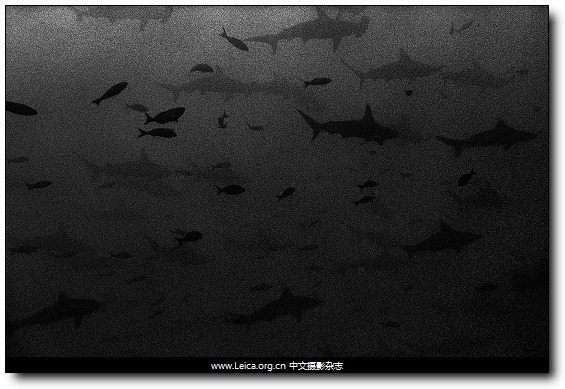
Dark Sharks/Light Rays
In 1983, I was given a Minolta Weathermatic for my birthday and it changed my life. What was it that fascinated me about the pictures made with this little yellow, instamatic, waterproof camera that has inspired me to photograph in and around water for 25 years? First, I shot black and white pictures underwater of children at play in pools, enlarging them to 20×24 inch prints. In those pictures I saw something unfamiliar and exciting. My perception changed and I discovered a newly transformed world of possibilities. The nature of water is infinite and in a constant state of flux. It struck me that through those pictures I captured fleeting moments of perfect harmony that were as temporal as the life of a bubble.
Next I began to photograph in open waters: rivers, springs, swamps, and oceans. I shot black and white at first and then color always using only natural light as it graced and veiled the watery landscapes. The light was always dramatic, reflecting, refracting, and bending through the water. At times it was elegant and at others foreboding. The photographs were unusual and seductive. They had the power to not only dazzle but also to inform the viewer about strange, unique and more often than not, endangered ecosystems. It is in this spirit that two complementary series developed: Dark Sharks and Light Rays.
On a recent trip to one of my favorite childhood haunts, the newly redesigned dinosaur hall at the Carnegie Museum of Natural History in Pittsburgh, a particular exhibit struck me. It was a magnificently designed underwater ocean scene. It was dark and dramatically lit reproducing the motion and quality of light above deep waters. The whole food chain was represented from scores of small fish hiding for protection in one massive bait ball to the largest creature overhead, the tylosaurus. The drama of life and survival was unfolding. What blew me away was the caption, which read “The scene before you represents a moment in time about 83 million years ago in what is now “Western Kansas”.
Dark Sharks and Light Rays are photographed in places that remind me of “Western Kansas”. Water still covers most of the planet: sharks and rays have been swimming on this Earth for eons. These creatures are closely related and prehistoric, so are the waters in which they swim. However, my locations, in Pacific waters off the Americas, though remote (one destination takes 32-36 hours to reach by boat), are deeply affected by many modern threats including: over fishing, illegal fishing, and shark fining. The shark population is plummeting and rays are following suit. It is not inconceivable to think they might follow the dinosaur into extinction.
These photographs are not the typical slicked up representation of the underwater worlds often found in scuba magazines. For example, the Dark Sharks are rendered in a way that is kindred to that of cave paintings. Our feeling towards these primeval animals comes from deep within our most primitive selves. The seas are often roiled and filled with current when the sharks are around but water has boundless variations and it is in a constant state of transformation. When the wild ocean calms, the flow between these intertwined series occurs organically, often on the same dive. The Light Rays are a counterpoint to the Dark Sharks. Where the Dark Sharks ask the viewer to bear witness to the power and visceral essence of the ocean, the Light Rays printed like graceful etchings represent the “Zen” of the ocean, and its peaceful, meditative qualities. But water is forever fickle; so occasionally and unexpectedly the line between the two groups is blurred by the whims of the sea.
These photographs provide a unique view – shot from a vantage point unfamiliar to most. The pictures lie in the realm of where natural history gives way to the ineffable. They are hard to classify but their subject is relevant and matters. Water is life’s stage and for as long as the stage door has been open to us, it has excited our creative and spiritual expression. The allure and mystery of these waters and the complicated puzzle of their continued existence inspires these pictures and continues to summon you and me to look even deeper.


Show Off your TLR
This thread is simply poisonous!
Show Off your TLR!
http://www.rangefinderforum.com/forums/showthread.php?t=41980

Yashica LM 44, review, tech specs, film 127
Overview and Personal Comments
The Yashica 44 LM is a twin-lens reflex (TLR) camera that is basically a copy of the Baby Rolleiflex. It uses 127 size film (just slightly smaller than standard 120 medium format) to shoot 44mm x 44mm “superslide” square format photos. The LM added a “Light Meter” to the Yashica 44, which is based on the Yashicamat system. The 44LM is the last of the 44 series. Using the text or images on this website without permission on an ebay auction or any other site is a violation of federal law.
I purchased this as part of a larger lot of cameras at an auction in North St. Paul in 2003.01. I was originally going to sell it to fuel my habit hobby, but looking at the photos that other people have taken (see links below), I was swayed to keep it. The Tessar type lens seems to really glow but in the end I ended up selling it.

Interesting quirks
The camera does not sport a cold-shoe for flash mounting! Instead you use an accessory shoe that mounts over the viewfinder.
 |
 |
 |
I talked with Mark Hama who worked in the factory that made these cameras. Apparently the 44LM came in 7 different colors and was known as the “rainbox” camera. My own is a light grey. This is the 40 year precursor to the multicolored Hasselblad 501CM! Using the text or images on this website without permission on an ebay auction or any other site is a violation of federal law.
Very new to that age, the camera has a built-in partially coupled CDs lightmeter. You dial in the ASA speed of your film, the camera body automatically relays the shutter speed, and you push the black “meter” button on the rear of the camera. The dial on the tells you which f/ stop to set your lens to. Great!

I can’t figure out for the life of me why there’s a ASA/DIN film reminder on the left focusing crank; and also one on the right film winding crank! One’s to calibrate the light meter, the other is…. all I can guess is that they kept the crank from the older 44.
127 film is harder to get these days, but you can still get it from B&H Photo in New York or Freestyle Photo in California. Yashica 44s are rare, most people will think you have a Baby Rollei.

Technical Details
|
Camera Name
|
44 LM |
|---|---|
|
Manufacturer
|
Yashica |
|
Place of Manufacture
|
Body: Japan |
|
Date of Manufacture
|
1958.4 ~ 1962.4 |
|
Focusing System
|
Twin lens reflex |
|
Fixed Lens
|
Taking lens: 60cm f/3.5 Yashinon (multicoated) Viewing lens: 60cm f/3.5 Yashinon (multicoated) |
|
Shutter
|
Copal S-V 1 sec – 1/500 sec. |
|
Metering System
|
Selenium cell mounted on camera body (above the lens ATL) GN 1-10 |
|
Flash Mount
|
M-X switch Cold-shoe mount on left side PC-cable attachment on front side |
|
Film type / speeds
|
Type 127 film (medium format) ASA 6-400 |
|
Battery type
|
hah! |
|
Dimensions and weight
|
|
|
Note: Using the text, table, or images on this site in an ebay auction without permission is a violation of your ebay Terms of Service. I will report you to ebay if I discover such a violation taking place. This may result in your account being cancelled. I also reserve the right to file claim for civil penalties.
|
|
About Yashica/Kyocera/Contax
The Yashica Corporation began making cameras in 1957, releasing its first model in 1958 (the Yashica 35). They produced a very well regarded series of twin-lens-reflex (TLR) medium format cameras under the Yashica-Mat brand and 35mm rangefinders under the Yashica Electro name. Yashica became a subsidiary of the Kyocera Corporation in October of 1983. For the next two decades, Kyocera continued to produce film cameras under the Contax marquee, including a very nice 35mmContax SLR series (which used Zeiss lenses), a medium format system, and the Contax G1/G2 rangefinders (also with Zeiss glass).The Yashica name was only used for a small series of dental cameras and point and shoots. In March of 2005, Kyocera announced that it would cease production and sales of film and digital cameras under the Contax marquee. Thus ends 30 years of a wonderful camera line. The Contax name will most probably revert back to the Zeiss foundation, thus who knows what will happen in the future. Right now, the name “Yashica” appears to have been bought by a Chinese company for their inexpensive digital cameras.
Manual for operating Yashica LM 44 can be found here.
The yashica LM 44 uses 127 film, which is very rare nowadays. developing the film is also going to be a problem.
here is an introduction to 127 film and places you can find them.
The 127 film is a paper-backed rollfilm, 4.6cm wide, originally designed to store eight pictures in 4×6.5cm format. It was created by Kodak for their Vest Pocket model – hence 127 was often called Vest Pocket film. Many of the first generation of 127 film cameras were similar folders, and frequently inherited Vest Pocket or VP in their names – for example the Dolly Vest Pocket. See Category: 4×6.5.
In 1930, during the Great Depression, the camera makers tried to optimize the use of film, and cameras began to appear taking 16 exposures in 3x4cm format on the 127 film, the first one being the Zeiss Ikon Kolibri. See Category: 3×4.
In Japan, the 127 film was called “Vest film” (ベストフィルム; Besuto firumu) until approximately the 1950s, because the film was introduced for the Vest Pocket camera.
In the 1950s there was a short revival of the 127 film with cameras designed to take 12 exposures in 4x4cm format. Several firms produced high-quality cameras, primarily twin-lens reflexes, in this format. The film was available in color slide emulsions, and the resulting 4x4cm slides could be projected in a normal projector designed for 24x36mm slides. They were advertised as Superslide. Kodak made such a range of very basic cameras. Rollei made a more advanced Rolleiflex Baby camera until the beginning of the 1960s. Togudu and Yashica in Japan produced outstanding examples. See Category: 4×4.
After the 1960s, 127 film declined in popularity as camera manufacturers focused on 35mm. Kodak ended production of 127 in 1995 and other major manufacturers immediately followed.
Fotokemika in Croatia was an exception, and it is still making highly-regarded “Efke” brand 127 black and white films. In 2006, Bluefire in Canada began manufacturing 127 C-41 color print films which are made using film stock from major factories, which is machine-rolled onto custom-manufactured spools and backing paper. Dick Haviland, a retired Kodak executive, has for many years made 127 films by hand from salvaged spools and custom-printed backing paper, which he sells through major on-line retailers. It is expected that 127 will continue to be available from boutique manufacturers for many more years.
 TLRgraphy