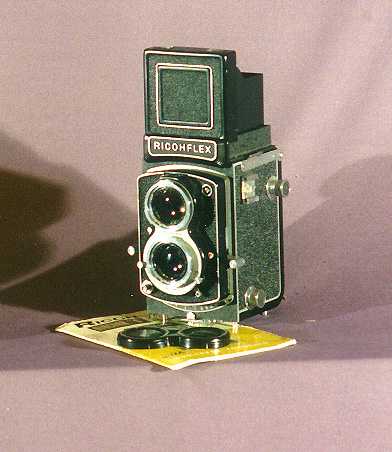
Rocoh Rocohflex TLR
A list of TLR models produced by Ricoh.
Ricohflex Model I, II and V: These model numbers were never used.
Ricohflex Model III: was introduced in 1950. It has the same f3.5 Anastigmat lens as later models but apertures are marked to f22 (instead of f16). Has the Riken shutter with B, 1/25, 1/50 and 1/100 speeds. Compared to the Model VII it has a smaller viewfinder magnifier and a back locking mechanism that isn’t as good. It has a folding viewfinder shade which was changed to the pop-up type in the Model IIIb (photo) which also has the later style larger viewfinder magnifier.
Ricohflex Model IV: Introduced in 1952. Earlier ones are labelled IIII which was later changed to the more correct Roman Numeral IV. Shutter speeds of B and 1/25 to 1/100 are supported. I don’t (yet) know what the differences are from the III and IIIB models.
Ricohflex Model VI: Introduced in 1953, is a manual 6×6 format camera without light meter, using knob film advance with “red window”.
Ricohflex Model VII and VIIs: Introduced in 1954 and 1955, are manual 6×6 format cameras without light meter, using knob film advance with “red window”. Some have the Auto-Stop feature.
Ricohflex Model VII (Seikosha shutter): Introduced in 1954. Has Seikosha shutter with speeds of 1 sec to 1/500 plus B.
Ricohflex Model VIIM: Introduced in 1956. Has shutter with speeds of 1/10 to 1/300 plus B.
Super Ricohflex: Introduced in 1956, is a manual 6×6 format camera without light meter, using knob film advance with “red window(s)”. Some models came from the factory with the Auto-Stop feature (though red window was still present). It was also available as a user-installed option (photo). There were four versions of the Super Ricohflex with three of them having 1/10 to 1/200 shutter speeds but one have 1 sec to 1/500 speeds.
Link to the Super Ricohflex user’s manual.
Ricohflex Holiday: Similar to the Model VII, it has the Riken shutter with limited shutter speeds (B, 1/25, 1/50 and 1/100) but has a flash shoe and film reminder on the wind knob like the Super Ricohflex.
Ricohflex Million: Similar to the Model VII, but has a Riken shutter with speeds from 1s to 1/300. And hot shoe on side as well as PC connector on front panel. Photo coming soon.
Ricohflex Dia: The original Diacord. The name plate says Ricohflex so it is sometimes confused with the geared focusing Ricohflexes. Some Diacord G’s appear to have been nameplated Ricohflex which adds to the confusion. The Diacord L manual shows the camera with a Ricohflex nameplate. So L’s may also have been produced with the Ricohflex nameplate.
Ricohflex Dia M: A cheaper version of the with speeds from 1/10 to 1/300. Photo coming soon.
Ricohflex: The next version of the Dia. Has bayonet 1 fittings on taking and viewing lenses. Has Riconar 3 element taking lens. Photo coming soon.
Diacord G: manual 6×6 format camera without light meter. Knob advance with automatic stop on next frame.
Link to the Ricoh Diacord G User’s Manual.
Diacord L: manual 6×6 format camera with uncoupled light meter. Knob advance with automatic stop on next frame.
Link to the metering section of the Diacord L User’s Manual.
Ricohmatic 225: manual 6×6 format camera, with uncoupled light meter. Has crankwind and shutter cocking with crank, automatic stop on next frame.
Ricoh Auto 66: match needle metered 6×6 format camera (similar to Rolleimagic). Knob advance with automatic stop on next frame.
Ikophot Exposure Meter – Made by Zeiss Ikon
Most of the TLRs do not come with built-in meter.
For TLRs come with built-in meter, most of these may not fully functional due the its age, or some functional but may not be accurate.
In these cases, a good exposure is very useful.
Managed to got a e-copy of Zeiss Ikon Ikophot exposure meter instructional manual, free download here.
Yashica Mat 124 in-depth review
Yashica Mat 124 – Review by Karen Nakamura
Overview and Personal Comments
The Yashicamat 124 is a twin-lens reflex (TLR) camera that is basically a copy of the Rolleiflex. It uses 120 size film (medium format) to shoot 6 x 6 square format photos (same as a Hasselblad). Using the text or images on this website without permission on an ebay auction or any other site is a violation of federal law.
I purchased this camera a couple of years ago to see if medium format was my thing. It was, the Yashica had excellent resolution and the tonality of medium format positives just blew me away.
Unfortunately, I was so entranced by the Yashicamat, I later on bought a Mamiya RB67 system and never used the Yashicamat after that. The RB67 is for the studio, while I have a Koni-Omega Rapid M for outdoor medium format photography. It’s just a bit difficult to frame when things are reversed in the TLR finder. I like the look of the 124 and the little Yashica 44LM, but I doubt I’ll ever use them.
Interesting quirks
The Yashicamat 124G is the successor to the 124. Everyone seems to want the 124G. The only change the 124G has was to add Gold meter contacts. That’s it. Which is odd since I’ve seen 124Gs that went for $400, but 124s are relatively cheap. They use the EXACT SAME OPTICS! Hmm.. People are pretty stupid. You don’t buy Yashicamats for the lightmeter, heck most of them are non-linear anymore. They use the EXACT SAME OPTICS!*
* OK, so the 124G had a nicer finish on the outside, BUT it also used wimpier (i.e., cheaper) gears. The 124 has sturdier internal mechanisms.
Sample Pictures
The Yashicamat 124 takes simply astoundingly sharp pictures. Here are some samples shot on Fuji Velvia (an E-6 slide film) and scanned with the Epson Perfection 2400, a standard flatbed scanner with a transparency adaptor that costs around $300. The resulting files are 5400 x 5400 pixels large, or 90 megabytes in size at 24 bit depth (at the scanner’s full 48 bit depth, the files are 180 megabytes large). That’s the equivalent of a 30 megapixel digital camera! You can print the scans at 240 dpi at a whopping 22″ x 22″ without interpolating. Try that on your $2000 digital camera!
A reduced version of each photo is shown along with a 8x zoom up. To put the zoomed in version in perspective, to view the zoomed version at 100%, the original file would have to be printed at almost 100″ x 100″ or an 8′ x 8′ mural. The actual slide shot is even sharper than the scan as the Epson 2450 is really a 1200 dpi scanner, not a 2400 dpi one.The slides themselves are extremely crisp. You can count the number of leaves on the trees in the autumnal photo (sample #2).
If you want the original sample files (about 3 megabytes compressed at JPEG 8; about 20 megabytes compressed at JPEG 12), please let me know and I will arrange to make them available.
 |
|
 |


The slight unsharpness here is caused by the scanner. With a loupe, you can make out the features of this person and easily identify him. Remember that this is the detail from an image blown up to about 8′ x 8′!
Technical Details
|
Camera Name
|
Yashicamat 124 |
|---|---|
|
Manufacturer
|
Yashica |
|
Place of Manufacture
|
Body: Japan |
|
Date of Manufacture
|
1968 ~ 1971 |
|
Focusing System
|
Twin lens reflex |
|
Fixed Lens
|
Taking lens: 80mm f/3.5 Yashinon (multicoated) Viewing lens: 80mm f/3.5 Yashinon (multicoated) -Yashinons are 4 element Tessar types |
|
Shutter
|
Copal S-V 1 sec – 1/500 sec. |
|
Metering System
|
CdS cell mounted on camera body (above the lens ATL) – uncoupled match needle type GN 1-10 |
|
Flash Mount
|
M-X switch Cold-shoe mount on left side PC-cable attachment on front side |
|
Film type / speeds
|
Type 120/220 film (medium format) ASA |
|
Battery type
|
PX625 |
| Use of this chart, text, or any photographs in an eBay auction without permission will result in an immediate IP violation claim with eBay VeRO. Violators may have their eBay account cancelled. | |
About Yashica/Kyocera/Contax
The Yashica Corporation began making cameras in 1957, releasing its first model in 1958 (the Yashica 35). They produced a very well regarded series of twin-lens-reflex (TLR) medium format cameras under the Yashica-Mat brand and 35mm rangefinders under the Yashica Electro name. Yashica became a subsidiary of the Kyocera Corporation in October of 1983. For the next two decades, Kyocera continued to produce film cameras under the Contax marquee, including a very nice 35mm Contax SLR series (which used Zeiss lenses), a medium format system, and the Contax G1/G2 rangefinders (also with Zeiss glass).The Yashica name was only used for a small series of dental cameras and point and shoots. In March of 2005, Kyocera announced that it would cease production and sales of film and digital cameras under the Contax marquee. Thus ends 30 years of a wonderful camera line. The Contax name will most probably revert back to the Zeiss foundation, thus who knows what will happen in the future. Right now, the name “Yashica” appears to have been bought by a Chinese company for their inexpensive digital cameras.
On the Net
|
 TLRgraphy