Mamiya TLR Restoration/ Repair Lessons
For the older photographers in our forum, that use or plan to use Mamiya TLR cameras and lenses. Here are my lessons learned from repairing a couple of used “chrome” Mamiya TLR lenses. The usual disclaimer, use the lessons learned at your own risk.
Zero, before you start handling the lenses wash your hands. Use a clean white towel on a well lighted table as your work area. Should a part or screw fall out it will not go far and can be seen.
First, do not remove the lens from the back plane frame, there is no need to access the lens from that side. Front and rear optical assemblies unscrew. There is no need to use a spanner wrench on the retaining clamps that secure the lens to the supporting frame.
Second, if the shutter will not cock the chances are a single screw has come loose within the shutter assembly that can be restored. This screw is located at the two O’clock position viewing the exposed taking lens shutter assembly straight on with upper rings and cam plate removed, viewing lens at 12 o’clock.
Third, if the shutter cocks but does not operate the blades when released a different screw is loose or has fallen out, that can be restored. This is located just south of the release lever mechanism. Check all screws for tightness.
Fourth, never use oil on any part of the shutter mechanism or ring assemblies or aperture assemblies.
Fifth, if the aperture blades mechanism is stuck or sticky, this can be cured using small amounts of 91% isopropyl rubbing alcohol applied with a damp Q-tip. To access the aperture internal assembly, This will require unscrewing the rear optical assembly. Work the mechanism manually using the aperture selector arm, do not touch the blades with your fingers and use another Q-tip to remove excess and any grime. Do not use oil. Be sure to remove any lint left behind by the Q-tips prior to reassembly.
Sixth, if the shutter ring is sticky or the clicks indents are not “sharp”, disassemble the two rings and clean them with isopropyl alcohol. Slightly bend the metal finger on the cam plate that engages the indents on the shutter selection ring.
Seventh, screws are tiny, and can be lost in a flash. For most repairs I have done only one screw has to be removed.
Eighth, acquire the proper tools, i.e. jewelers screwdrivers, needle nose tweezers, etc. A spanner wrench designed for lenses is required (see lesson 10) to remove the optical retaining rings that hold the individual elements. If you do this be sure to note on paper which side is up, in or out facing. Do not rely on your memory.
Ninth, use ROR per the instructions to clean the optics, and do not use canned air.
Tenth, use rubbing alcohol mentioned above with your finger tips (no fingernails, just skin) in a circular motion to remove fungus clouds from optical surfaces. It may require several times to completely remove the fungus. Do not allow excess to drip anywhere. Clean with a lint free, chemical free (no anti static chemicals used in the dryer), white cotton t-shirt. Then use ROR with a t-shirt to remove any residues.
So far, I have restored two Mamiya TLR chrome shutter lenses and both are working fine now. They were a lost cause when I started. They are simple in design and easy to restore.
If you have any second thoughts I recommend taking your lens to a repair facility. But if you are a risk taker and have some common mechanical sense, my lessons learned may prove useful. Search the web for other information sources, and photographs of the lens assembly.
Good luck,
d2f
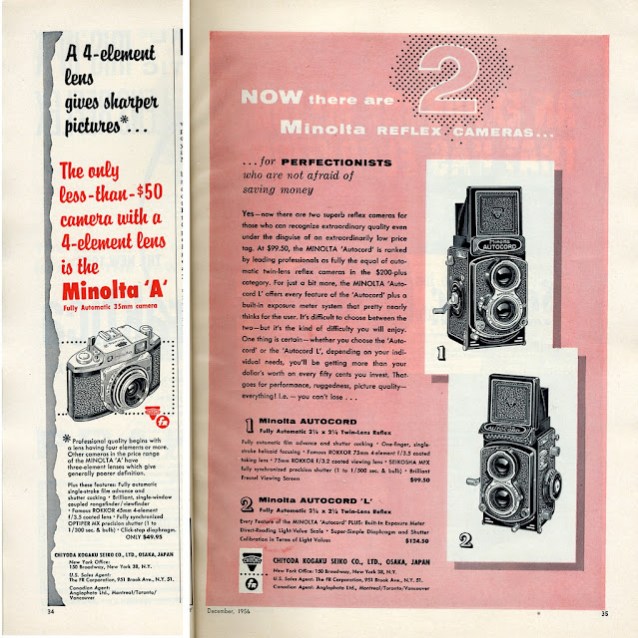
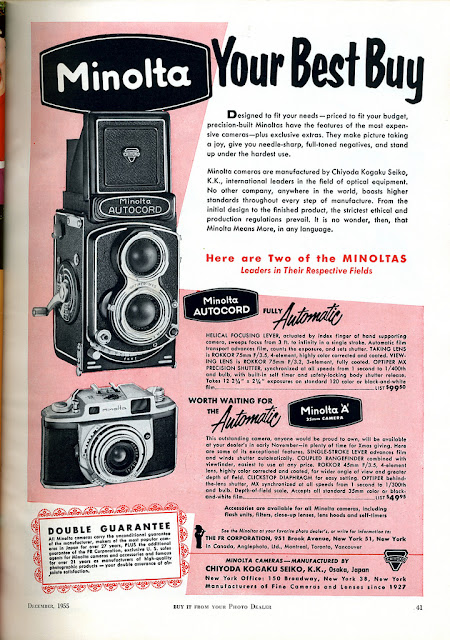
Vintage Minolta Autocord Advertisement
vintage everyday: Vintage Minolta Camera Advertising.
Pretty cool blog post on vintage camera advising. see how TLR was advised 40-60 years ago!


Yashica TLR VS Rollei TLR
perhaps this is the comparison between the most famous (or expensive) TLR and the most economical TLR. Or a comparison between TLRs made in Germany and Japan.
BTW, both are my fav. like them much better than the other few brands.
the below article is a shared opinion by “The Frugal Photographer”
The first post-war Japanese TLRs in general were not up to Rollei standards in any way. Some were junk. The Yashima company’s TLR factory produced the Pigeonflex/Yashimaflex/Yashicaflex line, decent but unexceptional goods, from about 1951 until the company transformed itself in 1955 by purchasing the Nicca company, at which time it renamed itself Yashica. They subsequently produced some very high quality TLR cameras, from 1957 until about 1984.
Between about 1957 and the early 1980’s, I would cheerfully rate the Yashica TLRs as better than the Rollei products with which they were meant to compete — the Rolleicords, and the Tessar and Xenar equipped f3.5 Rolleiflexes. The better, later, much more expensive Rolleiflexes are on a different plane. I don’t count the Yashica A, which was an entry-level, basic camera that didn’t pretend to compete with Rollei products.
The Yashica film wind mechanisms are not always as silky-smooth, but often they are, and even the worst are plenty smooth enough. They are robust enough for me, although the Rollei film wind gearing is stronger. The Yashica viewfinder screens incorporate fresnels and are substantially brighter and easier to use, and their lenses are of equal quality for all practical purposes (but not identical — Xenars have more “snap” to my eyes and Yashinons seem more subtle. Not everyone would agree).
The shutters are functionally equivalent, although I consider the Yashica’s Copal better designed than the Rollei’s Compur. The Copal has three speed range controllers, the Compur two, which has the practical consequence that the Copal will switch to 1/500 without effort, and you can switch to 1/500 when the shutter is cocked. Switching a Compur to 1/500 is remarkably difficult, and if you do so while the shutter is cocked you can ruin it. The Copal should stay more accurate longer — in theory.
The brighter viewscreen makes the Yashicas easier for me to handle, and earns them the “better than” rating. I would feel differently if it was 1960 and I was a busy pro who might easily wear out the Yashica film wind, or needed the Rolleiflex’s fast film reloading. But this is the 21st century, and neither I nor anyone reading this is likely to put film through a TLR by the mile, and none of us are using a TLR to shoot weddings. I’m nearsighted, and for me, moving from the comparable Rollei products to a Yashica-Mat at more or less the same price is definitely an upgrade.
The 124-G is usually overpriced and a Rolleicord or older Rolleiflex in good condition may be a better financial deal, e.g. $125 for a Rolleicord or decent Rollei Automat vs $200+ for a 124-G. In that case, don’t even think about the Yashica. Squint and bear it. Use the money you save to buy film.
Late 124-G’s (post-1980 approximately) sometimes had rough film winding mechanisms that fail prematurely. I have been told of late 124-G’s with no-name “Yashica” lenses instead of the high-quality Yashinon. However I have never seen one of these, and earlier specimens do not have these failings. The rough film-wind problems with the last of the 124-Gs are not widely acknowledged. I have been unable to pinpoint the region in the serial number range which marks the onset of problem cameras. In fact, I have no idea what the Yashica TLR serial number range is.
Non-124-G Yashicas are undervalued. The best of them is undoubtedly the plain-vanilla Yashica-Mat, a Rolleiflex clone without the film-thickness sensor, unmetered and usually available in excellent condition for much less money than a comparable Rollei TLR. It was manufactured continuously from 1957 to 1968 with the last models having f2.8 viewing lenses. Do not confuse the tough, attractive Yashica-Mat with the very early, flimsier Yashica-Flex.
There are selenium-celled versions of the Yashica-Mat, the Mat LM with LV readouts, and the Mat EM with direct f-stop/shutter speed readouts. Their selenium cells may work fine, but are now too old to be guaranteed reliable, and these metered models are worth owning, but not worth spending extra money for.
The Yashica-Mat 124 (just plain 124, non-G), an attractive, high-quality, CdS-metering machine, is equally as good. It will meter accurately if operated with a hearing-aid battery of the correct size. It was “improved” to make the 124-G, but the improvements are essentially trivial. The meter contacts of the G are gold plated. The G film chamber has improved anti-flare baffles. Nice, but not necessary.
If what you have is a ‘Mat, LM, EM, C, D, 635, 12, 24, 124, or 124-G, then use it. Don’t worry about trading “up” to a Rolleicord or f3.5 Tessar or Xenar Rolleiflex. You have nothing practical to gain, and the spiritual frisson some enthusiasts get from fondling Rollei gear doesn’t impress me. Knob wind film advance is just fine, not as sexy or as fast as lever wind and it doesn’t automatically cock the shutter, but it’s perfectly useful (and it lets you double-expose, if you’re into that).
If you have a YashicaFlex, or a Yashica A or E, then you should definitely trade up. You can do a lot better. The A is the one with that little red film number window on the back; the wretched E is a clone of the equally wretched Rolleimagic. Sell it on eBay, skip lunch for a week, and you’ll have enough to buy a Yashica D, Yashica-Mat, or Rolleicord.
If you have a Yashica B, Yashica Rookie, Pigeonflex, or a Yashimaflex, keep it — they’re decent if unexceptional performers — or sell it to a collector. They’re quite rare.
There is danger in generalizing about a line of cameras from handling one or two specimens. Here are my credentials:
My sample size in the years since about 1965 is probably on the order of a dozen Rollei and about 35 Yashica TLR cameras, of which I still own two Rolleis and 22 Yashicas (I’m collecting variations). I once regularly used a Rolleiflex Automat with Xenar (and an oddly attractive serial number, 107,0001), Rolleicord Va and Vb with Xenar, and various Yashica cameras with Yashikor and Yashinon lenses. I own but don’t use Yashica models A, B, and C, happily use my D, never shoot the screwball E, sometimes use the 635, 12, 24, 124, and 124-G, but prefer my late Yashica-Mat with f2.8 viewing lens.
I have owned, and tried to use, bad examples of Rollei products as well as bad examples of Yashica products. In my experience, neither marque has any monopoly on reliability except for the Rollei’s stronger film wind mechanism.
It needs to be said that the Minolta Autocord and Ricoh Diacord cameras are also fully the equal of the Rolleicord and f3.5 Xenar/Tessar Rolleiflexes, if not better, though they are less plentiful and not always less expensive. Abandoning one for a comparable Rollei would not be a step up. My sample size with these is three Autocords and two Diacords. They focus using lever mechanisms instead of knobs, which I could easily learn to prefer. The Diacord’s side-mounted focus levers in particular make it a lovely, wonderful to handle camera that makes the Rolleis and Yashicas seem awkward.
 TLRgraphy